If you're managing contacts, you might like our AI automation for Gmail labels. It helps you organize and label emails automatically.
Sending group emails in Gmail can be a time-consuming task, especially when managing large contact lists. However, by utilizing Gmail's label system, you can streamline the process and ensure that your messages reach the right people every time. In this step-by-step guide, we'll walk you through the process of creating labels, adding contacts to those labels, and composing group emails that maintain privacy and professionalism. With Bardeen's AI-powered automation, you can even automate the labeling process and save even more time on your email management tasks.
Understanding Gmail Labels and Groups
Gmail labels function as virtual folders, allowing you to organize your emails effectively. By creating labels, you can categorize and sort your messages, making it easier to find specific emails when needed. Labels are highly flexible, as you can apply multiple labels to a single email, unlike traditional folders where an email can only exist in one place.
Groups in Gmail are closely related to labels, as they allow you to manage and communicate with a specific set of contacts. By creating a label for a group of people, such as "Marketing Team" or "Project X Collaborators," you can quickly send emails to everyone in that group without having to enter each email address individually. This saves time and ensures that no one is accidentally left out of important communications.
To streamline your email management further, consider using Bardeen's AI-powered automation to classify and update labels on newly received emails automatically. This can help you maintain an organized inbox with minimal effort, allowing you to focus on more important tasks.
Creating and Managing Labels in Gmail
To create a new label in Gmail for organizing contacts:
Go to Gmail on your computer.
On the left sidebar, scroll down and click "More."
Click "Create new label."
Enter a name for your label, such as "Work Contacts" or "Family."
Click "Create" to save the new label.
To modify an existing label:
In Gmail, locate the label you want to edit on the left sidebar.
Hover over the label and click the three dots that appear.
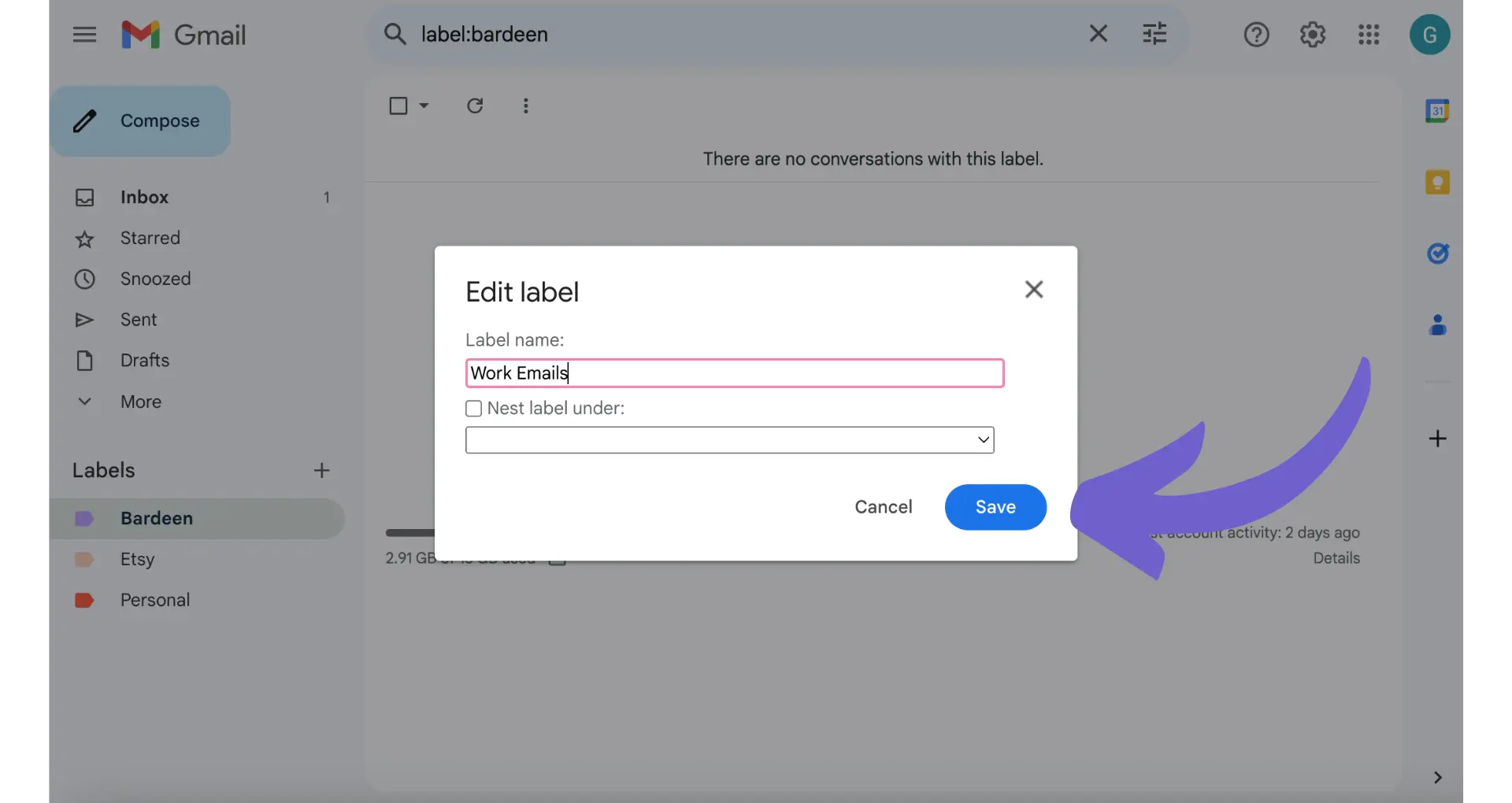
Select "Edit" from the dropdown menu.
Make your desired changes to the label's name or nesting.
Click "Save" to apply the changes.
To delete a label:
Find the label you want to remove on the left sidebar in Gmail.
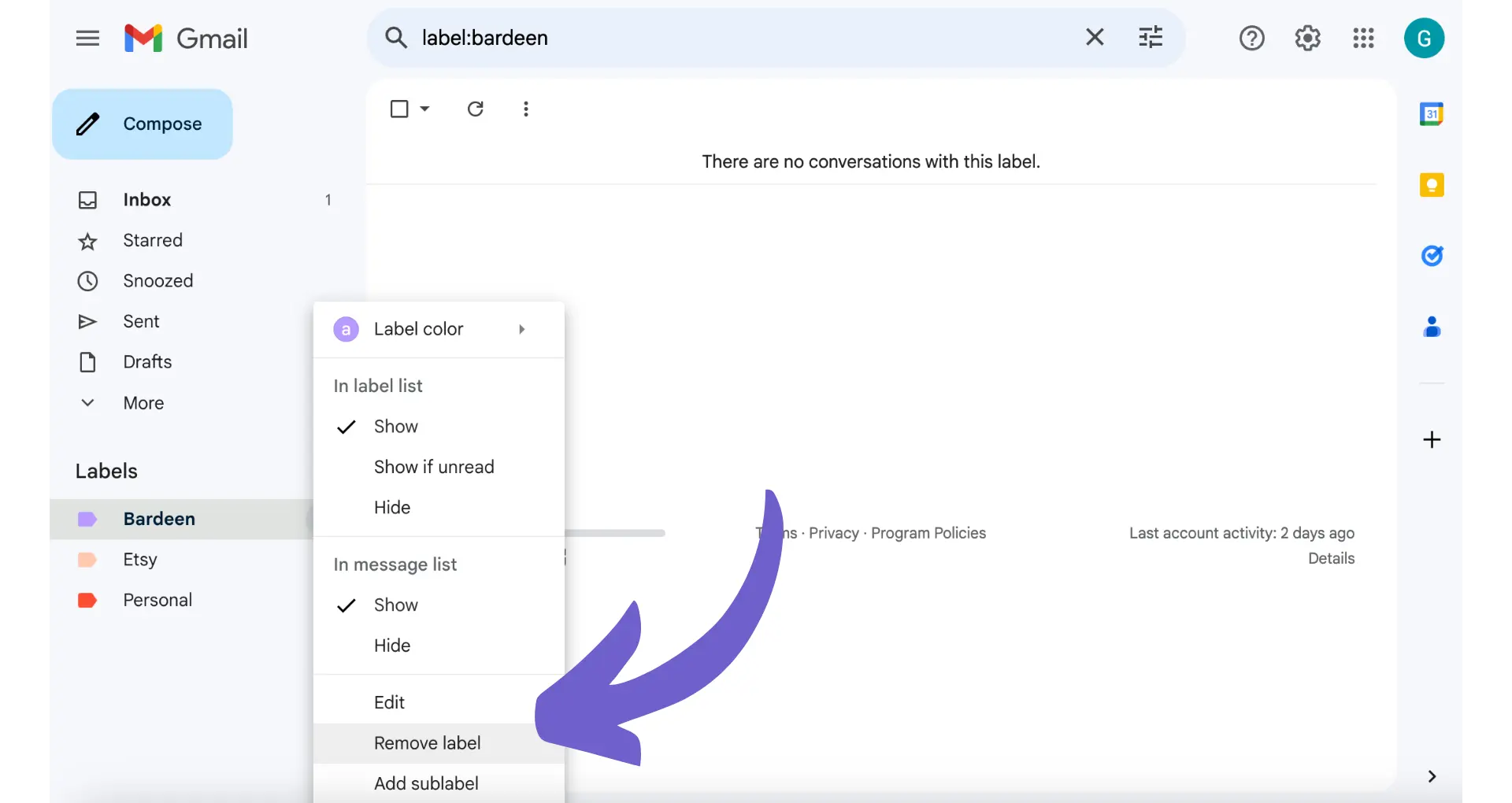
Hover over the label and click the three dots.
Choose "Remove label" from the dropdown menu.
Confirm the action by clicking "Delete" in the pop-up window.
To further streamline your label management, consider using Bardeen's AI-powered automation to classify and update labels on incoming emails automatically. This can save you valuable time and ensure consistent organization of your contacts and messages.
Select the contacts you want to add to a label by checking the boxes next to their names.
Click the "Manage labels" button (arrow-shaped icon) at the top of the page.
Select the label you want to add the contacts to.
Click "Apply" to save the changes.
Alternatively, you can drag and drop a single contact directly onto the desired label in the left sidebar.
When managing large contact lists, consider the following tips:
Use the search bar to quickly find and select specific contacts.
Take advantage of the "Select all" option to add all contacts to a label at once.
Regularly review and update your labels to ensure they remain accurate and relevant.
To further streamline the process of adding contacts to labels, you can use Bardeen's AI-powered automation to classify and update labels on incoming emails automatically. This can help you maintain organized contact lists for efficient group emailing.
Composing and Sending Group Emails
To compose an email addressed to a labeled group in Gmail:
Click the "Compose" button to start a new email.
In the "To" field, start typing the name of your label. Gmail will automatically suggest the label as you type.
Select the label from the suggestions to add all contacts within that label to the recipients list.
Compose your email as usual, including a subject line and message body.
If needed, you can also add individual recipients to the "CC" or "BCC" fields.
Review your email and click "Send" when ready.
When sending to a label group, consider the following tips for using the recipient fields:
Use the "To" field for the main recipients who are expected to take action or reply to the email.
The "CC" field is best for recipients who need to be kept in the loop but are not required to take direct action.
If you want to keep recipients' email addresses private from each other, use the "BCC" field. This can help reduce unnecessary "Reply All" responses.
When sending group emails in Gmail, follow these tips to maintain privacy and professionalism:
Use the "BCC" field when you want to keep recipients' email addresses private from each other. This helps prevent "Reply All" responses that may not be relevant to everyone.
Set clear expectations in your email about whether recipients should reply to the whole group or just to you.
Be mindful of the content you include in group emails. Avoid sharing sensitive or confidential information that may not be appropriate for all recipients.
Keep your email concise and to the point. Group emails are not the best place for lengthy discussions or back-and-forth conversations.
To effectively manage responses from group emails:
If a response requires a more in-depth discussion, suggest moving the conversation to a different channel, such as a video call or a dedicated chat thread.
By following these best practices and leveraging automation tools, you can ensure your group email communications remain professional, efficient, and effective.

SOC 2 Type II, GDPR and CASA Tier 2 and 3 certified — so you can automate with confidence at any scale.
Frequently asked questions
What is Bardeen?
Bardeen is an automation and workflow platform designed to help GTM teams eliminate manual tasks and streamline processes. It connects and integrates with your favorite tools, enabling you to automate repetitive workflows, manage data across systems, and enhance collaboration.
What tools does Bardeen replace for me?
Bardeen acts as a bridge to enhance and automate workflows. It can reduce your reliance on tools focused on data entry and CRM updating, lead generation and outreach, reporting and analytics, and communication and follow-ups.
Who benefits the most from using Bardeen?
Bardeen is ideal for GTM teams across various roles including Sales (SDRs, AEs), Customer Success (CSMs), Revenue Operations, Sales Engineering, and Sales Leadership.
How does Bardeen integrate with existing tools and systems?
Bardeen integrates broadly with CRMs, communication platforms, lead generation tools, project and task management tools, and customer success tools. These integrations connect workflows and ensure data flows smoothly across systems.
What are common use cases I can accomplish with Bardeen?
Bardeen supports a wide variety of use cases across different teams, such as:
Sales: Automating lead discovery, enrichment and outreach sequences. Tracking account activity and nurturing target accounts.
Customer Success: Preparing for customer meetings, analyzing engagement metrics, and managing renewals.
Revenue Operations: Monitoring lead status, ensuring data accuracy, and generating detailed activity summaries.
Sales Leadership: Creating competitive analysis reports, monitoring pipeline health, and generating daily/weekly team performance summaries.