Converting currencies is a common task for businesses and individuals dealing with international transactions. Google Sheets offers a powerful built-in function called GOOGLEFINANCE that makes it easy to convert USD to CAD and other currency pairs. In this step-by-step guide, we'll show you how to use the GOOGLEFINANCE function to quickly and accurately convert USD to CAD in your Google Sheets.
The GOOGLEFINANCE function is a powerful tool in Google Sheets that allows you to retrieve real-time financial data, including currency exchange rates, directly from Google Finance. This function is essential for converting currencies like USD to CAD within your spreadsheets. Here's what you need to know about the basics and syntax of the GOOGLEFINANCE function:
GOOGLEFINANCE(ticker, [attribute], [start_date], [end_date|num_days], [interval])ticker parameter is mandatory and represents the currency pair you want to convert, such as "CURRENCY:USDCAD" for USD to CADattribute parameter specifies the type of data to retrieve, defaulting to "price" for the current exchange ratestart_date and end_date|num_days parameters to fetch historical exchange rates for a specific periodBy leveraging the GOOGLEFINANCE function, you can ensure that your currency conversions are always based on the most up-to-date exchange rates, eliminating the need for manual updates. For more advanced features, consider using GPT in Spreadsheets to bring AI into your Google Sheets workflow.
To convert USD to CAD in Google Sheets, you'll need to use the GOOGLEFINANCE function with the appropriate currency pair. Here's how to set up the formula:
=GOOGLEFINANCE("CURRENCY:USDCAD")Let's break down the components of this formula:
GOOGLEFINANCE is the function that retrieves financial data from Google Finance"CURRENCY:USDCAD" is the ticker parameter, specifying the currency pair (USD to CAD)
To convert a specific amount of USD to CAD, simply multiply the amount by the GOOGLEFINANCE formula. For example, to convert $100 USD to CAD, use the following formula:
=100*GOOGLEFINANCE("CURRENCY:USDCAD")
This will calculate the equivalent amount in Canadian dollars based on the current exchange rate. For more advanced features, you can connect Google Sheets with other apps to automate your workflows.
Save time on repetitive tasks by scraping data from websites and automating the process with Bardeen's AI-powered tool.

To make your currency conversion formula more dynamic and adaptable to different data entries, you can use cell references instead of hardcoding the USD amount. Here's how:
For example, if your USD value is in cell A2, your formula in cell B2 would be:
=A2*GOOGLEFINANCE("CURRENCY:USDCAD")
Now, whenever you change the USD value in cell A2, the converted CAD amount in cell B2 will automatically update based on the current exchange rate.
You can apply this formula to an entire column by dragging the formula down from cell B2. This way, you can convert multiple USD values to CAD in one go, making your spreadsheet more efficient and adaptable to new data entries.
If you need more advanced features, consider using tools that connect Microsoft Excel with other platforms for better automation and efficiency.
The GOOGLEFINANCE function in Google Sheets can also be used to fetch historical exchange rates for specific dates or periods. To retrieve historical data, you need to modify the formula by adding additional parameters:
Here's an example of a formula that retrieves the historical exchange rate for USD to GBP on January 1, 2023:
=GOOGLEFINANCE("CURRENCY:USDGBP","price",DATE(2023,1,1),DATE(2023,1,1),"DAILY")
To retrieve historical data for a specific period, you can modify the formula like this:
=GOOGLEFINANCE("CURRENCY:USDGBP","price",DATE(2023,1,1),DATE(2023,1,31),"WEEKLY")
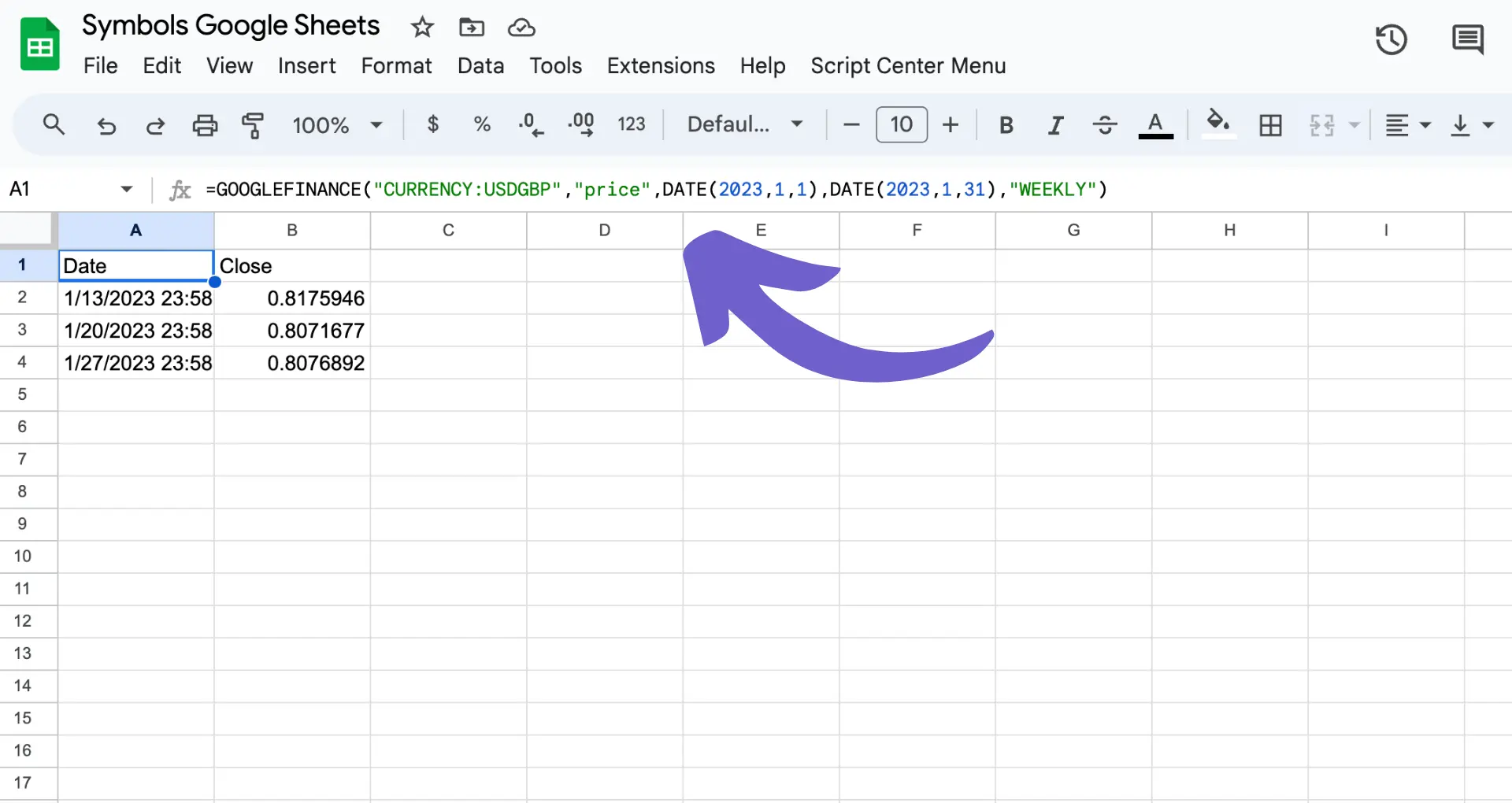
This formula will return the weekly exchange rates for USD to GBP from January 1, 2023, to January 31, 2023. For more advanced data handling, consider using GPT in Spreadsheets.
Bardeen can help lighten your workload. You can easily enrich LinkedIn profiles directly in Google Sheets, saving time on manual entries.
To ensure accurate and efficient currency management in Google Sheets, consider the following best practices:
By following these best practices, you can ensure that your currency conversions in Google Sheets remain accurate and up-to-date, enabling you to make informed financial decisions and maintain reliable records. For more advanced tips, consider using tools to scrape data from websites for your financial analysis.









SOC 2 Type II, GDPR and CASA Tier 2 and 3 certified — so you can automate with confidence at any scale.