
This automation streamlines the process of migrating contact information from HubSpot to Google Sheets based on company names. It's ideal for marketing and sales professionals looking to consolidate their contact lists or prepare for campaigns.
The workflow begins by retrieving a Google Sheet that lists company and contact names. It then locates the corresponding company in HubSpot using the company name and finds the contact within that company by name. Finally, it appends a new row to the Google Sheet with the company name, contact name, and email address obtained from HubSpot.
Pro Tip: This workflow can be customized to include additional fields from HubSpot, such as phone number or job title, depending on the specific needs of your marketing or sales campaigns.
By automating the migration of contacts based on company names, users can efficiently organize their contact lists in Google Sheets, making it easier to manage outreach and follow-up activities.
To start, ensure you have the Bardeen app installed on your device.
Open the Bardeen app and go to the Magic Box. Input the prompt:
Get Google Sheet row, Find Company name in HubSpot, Migrate Contact to Google Sheets
For this workflow to function, you must integrate Google Sheets for contact information storage and HubSpot for finding company and contact details.
After setting up, run the workflow. This process will:
Managing contact information between HubSpot and Google Sheets can be streamlined through automation, ensuring that your sales and marketing teams have the most up-to-date information at their fingertips. This process involves setting up workflows that automatically migrate contact information from HubSpot to Google Sheets based on company names. This automation is particularly useful for consolidating contact lists or preparing for targeted campaigns.
Discover how Bardeen can automate the migration of contact information from HubSpot to Google Sheets, enhancing your productivity.
To begin, you must connect Google Sheets to your HubSpot account. This can be done through the HubSpot App Marketplace or directly within a workflow. Once connected, you can use the "Create Google Sheet row" or "Update data in a Google Sheet" actions in HubSpot workflows to send data from HubSpot properties to your spreadsheet. It's important to properly format your Google Sheet, ensuring that the header row starts in the first column of the first row and each column header is clearly labeled.
When integrating external systems with HubSpot or when you need to locate specific contacts, the HubSpot API allows you to search for contacts by their email address. By making a POST request to the /crm/v3/objects/contacts/search endpoint with the appropriate filters, you can retrieve contact information based on the email address.
The automation workflow begins by retrieving a row from a Google Sheet that lists company and contact names. It then locates the corresponding company in HubSpot using the company name and finds the contact within that company by name. Finally, it appends a new row to the Google Sheet with the company name, contact name, and email address obtained from HubSpot. This process can be customized to include additional fields from HubSpot, such as phone number or job title, depending on your campaign needs.
By automating the migration of contacts based on company names, you can efficiently organize your contact lists in Google Sheets, making it easier to manage outreach and follow-up activities. Learn more about automating your workflows with Bardeen.
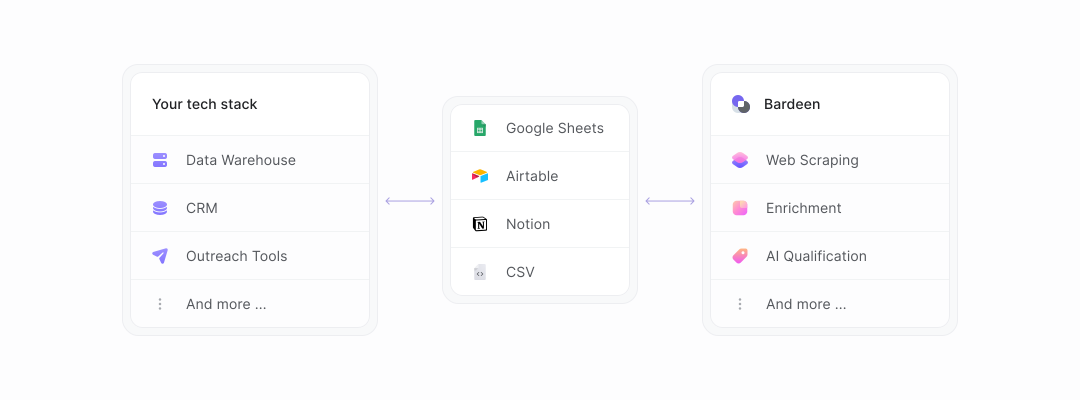
With our new Bardeen version, you can easily extract data from any website and discover new leads across the web. After extracting data from a website, use Bardeen’s powerful automation tools to validate and enrich your data, run additional scrapers on linked pages, or leverage AI to qualify leads and generate content automatically. Once your data is ready, you can easily export it to CSV, Google Sheets, Airtable, or Notion for further analysis and reporting.






SOC 2 Type II, GDPR and CASA Tier 2 and 3 certified — so you can automate with confidence at any scale.