
This automation streamlines the process of scraping Google Product Reviews for a specific product and saving them directly into a Google Sheets tab.
Initially, the automation activates a combined scraper model on the current tab, targeting a given product URL to scrape Google Product Reviews. Following the successful extraction of data, it then appends this valuable information into a pre-specified Google Sheets tab. This workflow is particularly beneficial for:
Note: The workflow's modularity allows adaptation to various data scraping and storage needs, enabling compatibility with other data sources and storage solutions like Airtable or CRM systems.
Employ this workflow to effortlessly gather and organize product reviews, enhancing data-driven decision-making processes. Try Bardeen to implement this automated workflow seamlessly.
To start, ensure the Bardeen app is installed on your device.
Open the Magic Box and enter:
Scrape Google Product Reviews then save into Google Sheets
Connect the Scraper for scraping Google Product Reviews and Google Sheets for saving the scraped data.
Execute the workflow to:
Extracting Google Reviews is a crucial task for businesses and individuals looking to gather insights from customer feedback. Whether it's for market research, competitor analysis, or improving customer experience, having access to these reviews can be invaluable. There are several ways to extract reviews from Google, including manual methods and using specific tools or programming approaches.
Ready to streamline the process of extracting Google Product Reviews? Try Bardeen to automate this task seamlessly. Start now!
One of the straightforward methods to export Google Reviews is to use third-party widgets or tools like the Google Reviews widget by Elfsight. This method involves connecting your Google My Business profile to the widget, which then automatically pulls reviews to your website or blog. The process is simple: sign up or log in to the widget's platform, choose and customize a template, and then embed the provided code into your website. This method is advantageous for those looking to display reviews directly on their site without the need for constant updates.
Another approach is using the official Google API to export reviews. This method requires more technical knowledge, including registering your application, obtaining OAuth 2.0 credentials, and enabling the API for your project. With the API, you can perform various actions such as listing all reviews, getting specific reviews, and even replying to or deleting replies to reviews. This method is suitable for those needing more control over the data extraction process and who are comfortable with technical setups.
For those with programming knowledge, creating a Google Reviews scraper using Python presents a more flexible and powerful solution. This approach involves using libraries such as BeautifulSoup or Selenium to automate the process of extracting reviews. With Python, you can develop a custom scraper that navigates Google Maps, locates the reviews section of a business, and extracts the required information.
When using Selenium, you control a browser session to interact with Google Maps, mimicking human actions to access and scrape reviews. This method is particularly useful for dealing with dynamic content generated by JavaScript, which is common on modern websites. After setting up Selenium and the necessary drivers, you can write Python code to open Google Maps, search for a specific location, and programmatically click through to extract reviews.
BeautifulSoup, on the other hand, is used for parsing HTML and XML documents. Combined with requests to fetch the webpage content, BeautifulSoup allows you to navigate and search the document tree to extract the needed data. This method is less resource-intensive than Selenium but might require additional steps to handle dynamic content.
Automate the extraction of Google Product Reviews directly into Google Sheets with Bardeen. Enhance your data analysis and decision-making process. Try it now!
Regardless of the method chosen, extracting Google Reviews can provide valuable insights. For those looking for a no-code solution, tools like Bardeen offer a straightforward way to automate these tasks, saving time and resources. Whether you're a marketer, data scientist, or business owner, accessing and analyzing Google Reviews can drive better business decisions and strategies.
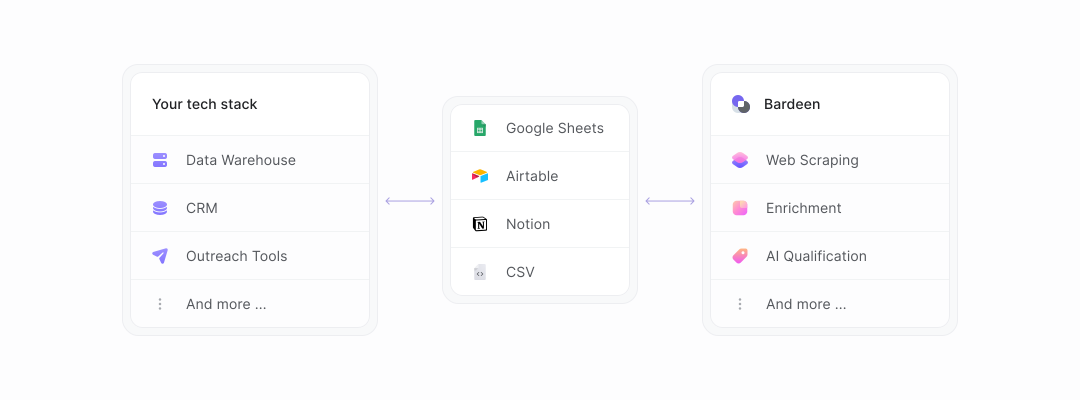
With our new Bardeen version, you can easily extract data from any website and discover new leads across the web. After extracting data from a website, use Bardeen’s powerful automation tools to validate and enrich your data, run additional scrapers on linked pages, or leverage AI to qualify leads and generate content automatically. Once your data is ready, you can easily export it to CSV, Google Sheets, Airtable, or Notion for further analysis and reporting.






SOC 2 Type II, GDPR and CASA Tier 2 and 3 certified — so you can automate with confidence at any scale.