
This automation transfers data from a Google Sheet and uses it to create new companies in HubSpot. It's ideal for sales and marketing teams looking to streamline their CRM update process.
The workflow begins by retrieving the contents of a specific Google Sheet as a table, where each row represents a company with details such as the company's name, domain, description, industry, and number of employees. Next, for each row in the Google Sheet, a new company is created in HubSpot with the corresponding data. This process ensures that your HubSpot CRM is always up-to-date with the latest company information.
Note: This workflow can be customized to match the specific data fields you use in your Google Sheets and HubSpot accounts. Additionally, Bardeen supports integration with other CRMs like Salesforce, Pipedrive, and more.
Automating this process saves time and reduces the risk of manual data entry errors, allowing teams to focus on more strategic tasks. Use this workflow to keep your sales pipeline filled with fresh prospects.
To start, ensure the Bardeen app is installed on your device.
After installation, proceed to the Magic Box and input the command:
Get data from GoogleSheets, Create new HubSpot Company
Integrate the workflow integrations required, which are Google Sheets for the source and HubSpot for the destination.
Finally, execute the workflow. This workflow is set up to:
For businesses leveraging both HubSpot for CRM and Google Sheets for data analysis and reporting, creating a seamless integration between the two platforms can significantly enhance productivity and data accuracy. This integration allows for the automatic creation of HubSpot companies from data within Google Sheets, streamlining processes for sales and marketing teams.
By utilizing Bardeen, teams can automate the transfer of data from Google Sheets to HubSpot, ensuring that the CRM is always updated with the latest company information without manual data entry.
To begin, it's essential to connect Google Sheets to your HubSpot account, which can be done via the HubSpot App Marketplace or directly within a workflow in HubSpot. This connection enables the use of actions such as 'Create Google Sheet row' or 'Update data in a Google Sheet' within HubSpot workflows, allowing for the automatic sending of data from HubSpot properties to your spreadsheet.
When setting up your spreadsheet for integration, ensure that the header row starts in the first column of the first row and each column header is labeled. This labeling is crucial as HubSpot identifies and sends data to labeled columns only. Additionally, avoid manually adding data to the sheet that HubSpot is sending data to, to prevent data discrepancies.
With the integration set up, you can automate the creation of new companies in HubSpot based on data from Google Sheets. This process involves setting up a workflow in HubSpot that triggers the 'Create Google Sheet row' action. Select the appropriate spreadsheet and sheet where you want to send data, and map out the columns in Google Sheets to the corresponding properties in HubSpot.
For updating existing rows with new data, use the 'Update existing Google Sheet rows' action. This requires setting up unique identifiers to match the data in Google Sheets with the data in HubSpot, ensuring that only the intended rows are updated.
This automation, facilitated by Bardeen, not only saves time but also minimizes the risk of manual data entry errors, allowing teams to focus on more strategic tasks.
For more technical users, integrating HubSpot API with Google Sheets via Google Apps Script offers a way to customize the data transfer process further. This method involves writing a script that triggers a POST request to the HubSpot API when specific cell ranges in your spreadsheet are updated. While this approach requires some programming knowledge, it provides flexibility in handling complex data synchronization scenarios.
Regardless of the method chosen, integrating HubSpot with Google Sheets can significantly improve data management processes, making it easier for teams to maintain up-to-date and accurate data across platforms.
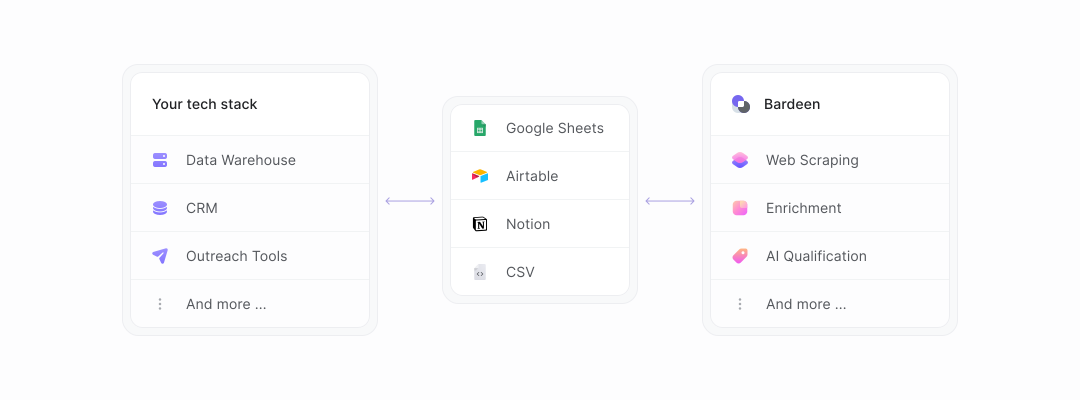
With our new Bardeen version, you can easily extract data from any website and discover new leads across the web. After extracting data from a website, use Bardeen’s powerful automation tools to validate and enrich your data, run additional scrapers on linked pages, or leverage AI to qualify leads and generate content automatically. Once your data is ready, you can easily export it to CSV, Google Sheets, Airtable, or Notion for further analysis and reporting.






SOC 2 Type II, GDPR and CASA Tier 2 and 3 certified — so you can automate with confidence at any scale.