This automation enables the conversion of a downloaded file into text using OpenAI's powerful model. It's particularly useful for extracting text from documents that are not originally in editable text formats.
The process begins by downloading a file from a specified URL. Following the download, the file is uploaded to OpenAI, where it is converted into text based on the content of the file. This is ideal for:
Note: Bardeen supports a variety of file types and sources for download, and the OpenAI model can be adjusted according to your needs for temperature and specificity.
Enhance your productivity by automating the conversion of files to text with Bardeen.
Begin by installing the Bardeen app if you haven't done so already.
Open the Bardeen app and go to the Magic Box. Enter the following prompt:
download file, upload to openai, convert to text
Make sure to set up the necessary integrations with the workflow, which includes OpenAI for text conversion.
Now, execute the workflow. This workflow is designed to:
Converting audio files to text is a task that has become increasingly necessary for professionals across various fields, from journalists and podcasters to researchers and educators. This process, known as transcription, can be performed through various methods and tools, each with its own set of advantages. Let's explore how to manually convert audio files to text, focusing on methods that do not rely on another product.
Enhance your productivity by automating the conversion of files to text with Bardeen. Try it now!
Manual Transcription: The most straightforward method is to listen to the audio and type out the content manually. This method, while time-consuming, ensures high accuracy, especially in cases where the audio quality is poor or contains technical jargon specific to a field.
Using Online Tools: Several online platforms offer audio-to-text conversion services. These tools typically support various audio formats such as WAV, MP3, M4A, and more. The process generally involves uploading the audio file, selecting the language of the audio (if the tool supports multiple languages), and then waiting for the tool to convert the audio to text. Some platforms might require you to enter an email address to receive the transcript.
Google Docs Voice Typing: For real-time transcription, Google Docs offers a voice typing feature. Although it doesn't directly transcribe audio files, you can play the audio through speakers and use the voice typing feature to transcribe. This method requires a quiet environment and good quality audio to be effective.
Once you have your transcript, summarizing the content can be efficiently done using ChatGPT. Here's how:
1. Copy the text of your transcript to your clipboard.
2. Open ChatGPT and paste the transcript into the chat.
3. Provide ChatGPT with a prompt, such as "Summarize this transcript focusing on the main points."
ChatGPT will then process the transcript and return a summary that captures the essence of the audio content. This method is particularly useful for extracting key information from long recordings, making it easier to analyze and share insights.
Ready to streamline your workflow? Automate your transcription and summarization tasks with Bardeen. Get started here.
Remember, while automated tools and AI like ChatGPT can significantly speed up the transcription and summarization process, they may not always be 100% accurate. It's always a good idea to review the final text for any errors or inaccuracies, especially when dealing with complex topics or poor audio quality.
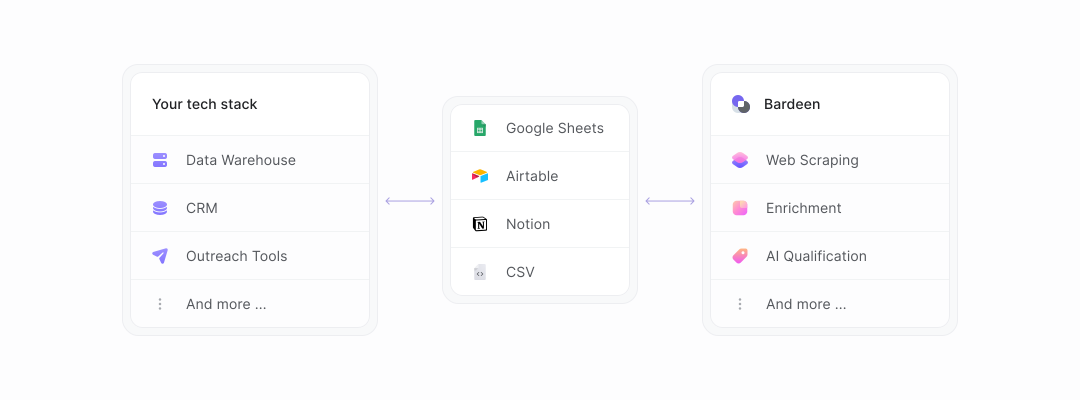
With our new Bardeen version, you can easily extract data from any website and discover new leads across the web. After extracting data from a website, use Bardeen’s powerful automation tools to validate and enrich your data, run additional scrapers on linked pages, or leverage AI to qualify leads and generate content automatically. Once your data is ready, you can easily export it to CSV, Google Sheets, Airtable, or Notion for further analysis and reporting.






SOC 2 Type II, GDPR and CASA Tier 2 and 3 certified — so you can automate with confidence at any scale.