We’ve all been there: sales targets get increasingly aggressive while sales teams are stretched thinner and thinner. Manual outreach is just too time-consuming, and personalization does not scale well.
Does this sound familiar? Are you ready to say goodbye to endless cold leads and hello to a steady stream of qualified leads?
If so, it’s time to update your tech stack.
In this step-by-step guide, I'll show how to properly use AI for B2B lead generation. You’ll learn how to build accurate buyer personas, qualify leads, and craft personalized messaging that converts — all at the drop of a hat!
B2B lead generation is a strategic process that involves finding and engaging with potential customers to build prospect lists and create business opportunities. AI B2B lead generation software automates and optimizes workflows by analyzing vast amounts of data, predicting customer behavior, and personalizing outreach efforts.
Although not a linear process, B2B lead generation typically involves four main stages and AI can be used at each stage to make work easier:
AI analyzes sales and customer data to create accurate buyer personas. Bardeen can automate this process with pre-built, fully customizable templates, such as:
.png)
How does this playbook work?
This playbook will generate research or gather relevant news from the web based on your prompt and will save the information to a Google Sheets spreadsheet.
AI-powered web scrapers extract contact info from sites, social media platforms, business directories, and other sources. Then, personalized, automated cold outreach starts the conversation.
Here are some Bardeen automations to help with that:

How does this playbook work?
Need to quickly pull data from a LinkedIn profile? This playbook scrapes key information from the active LinkedIn profile tab, giving you structured data in seconds.


How does this playbook work?
This playbook will analyze the last few posts from the profile and create a personalized intro message.
AI analyzes large volumes of data to qualify prospects and predict who is most likely to convert and what leads can be nurtured.
To qualify leads with Bardeen, you can start from:

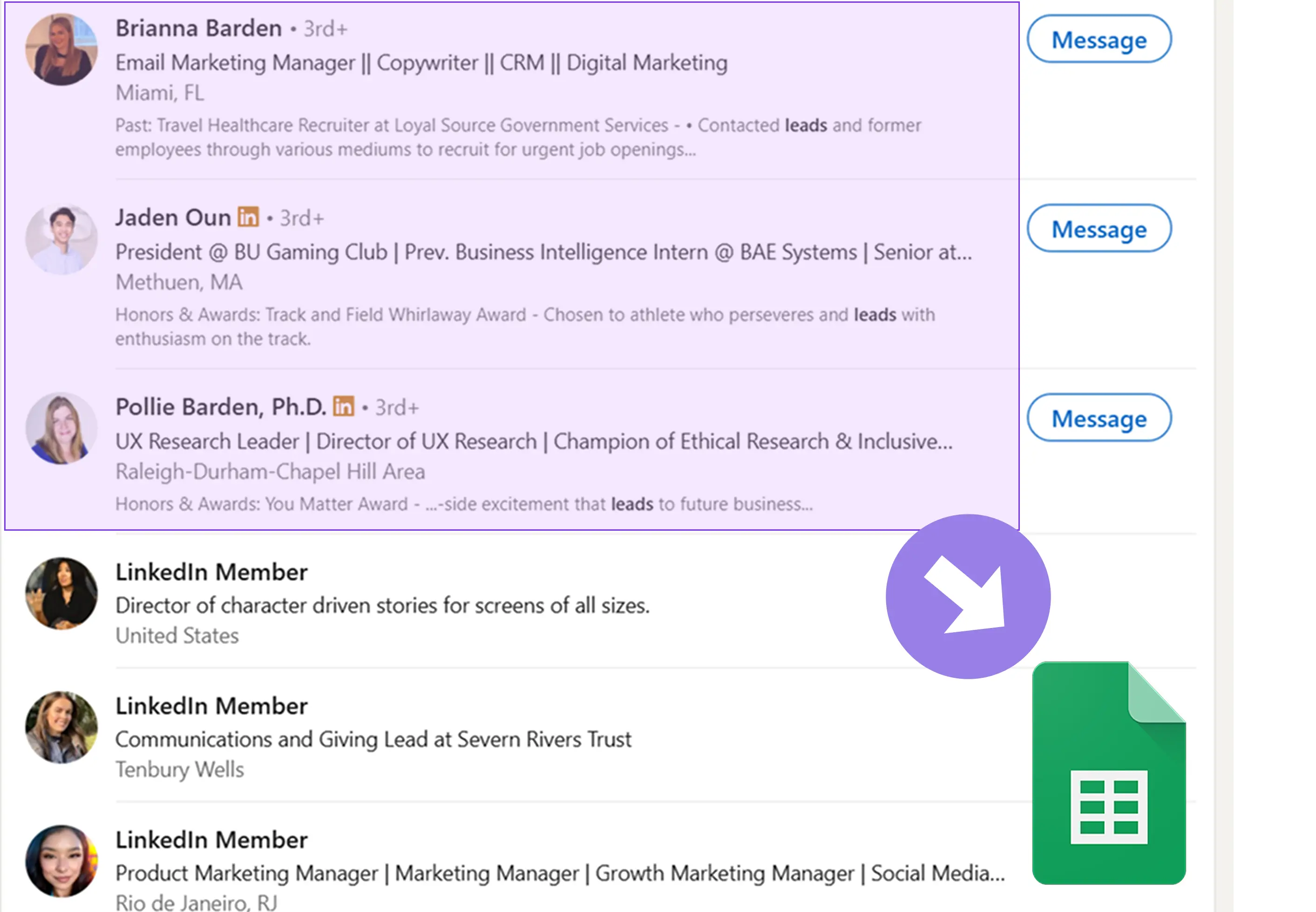
How does this playbook work?
LinkedIn lead qual is time-consuming. This playbook scrapes profile data from a search, uses AI to qualify leads based on your criteria, and saves results to Google Sheets automatically.

How does this playbook work?
Qualifying leads is time-consuming and error-prone. This playbook pulls leads from a Google Sheet, enriches them with data from Apollo and LinkedIn, qualifies them using a custom classifier, and saves the results to a new sheet – automating the entire process.
AI-powered writing assistants craft personalized messaging and automatically enroll leads into a nurture sequence until they are ready to convert.
Using AI for lead generation can help make the process more efficient, personalized, and data-driven. Tools like Bardeen can help accelerate your cycle, but to get the most out of your AI-powered lead generation programs, you need to continually measure performance and optimize your strategies.
B2B brands need to be on the cutting edge if they want to stay relevant. Using AI for B2B lead generation helps you maintain a lean and efficient team while still scaling your lead count.
But if that’s not convincing enough, consider these current AI trends:
Teams that ignore AI are already falling behind and will continue to do so if they don’t adapt quickly. Here are the key ways you can use AI for B2B lead generation:
67% of sales leaders say their reps spend at least 11 hours per week on research and follow up. Assuming your team works a standard 40-hour week, that is about 25% of their time!
You can easily reduce that wasted time by incorporating AI to automate your follow up sequences. Imagine what your team could accomplish with an extra 5 - 6 hours in their week. They could spend that time building stronger relationships or working on additional leads.
You need to know EXACTLY who your best customers are if you want to get more of them. AI can create insanely accurate buyer personas by analyzing large volumes of data and recognizing patterns over long periods of time.
For example, you can pull insights from publicly available sources and enrich customer profiles with firmographic and demographic data.
You can use Bardeen to achieve just that:


How does this playbook work?
Understanding customers is key for product and marketing, but analyzing data is time-consuming. This playbook generates a detailed buyer persona report in a new Google Doc by analyzing a Google Sheet with customer data using AI.
But it doesn’t stop with buyer personas. 54% of businesses are currently using predictive AI in their lead generation. By that I mean they are using AI to make accurate predictions about which leads are most likely to close so that reps can prioritize their tasks better.
AI can also uncover other patterns that might benefit your team. For example, AI might discover that phone calls where you speak less than 60% of the time are less likely to close. Teams can use this data to adjust their sales approach.
AI can analyze more data and do it faster than any human can, making it easy to create personalized messages at scale. Marketing teams simply need to create a reusable template and populate it with personalization tokens. Then Bardeen can be used to craft personalized messages with dynamic content:

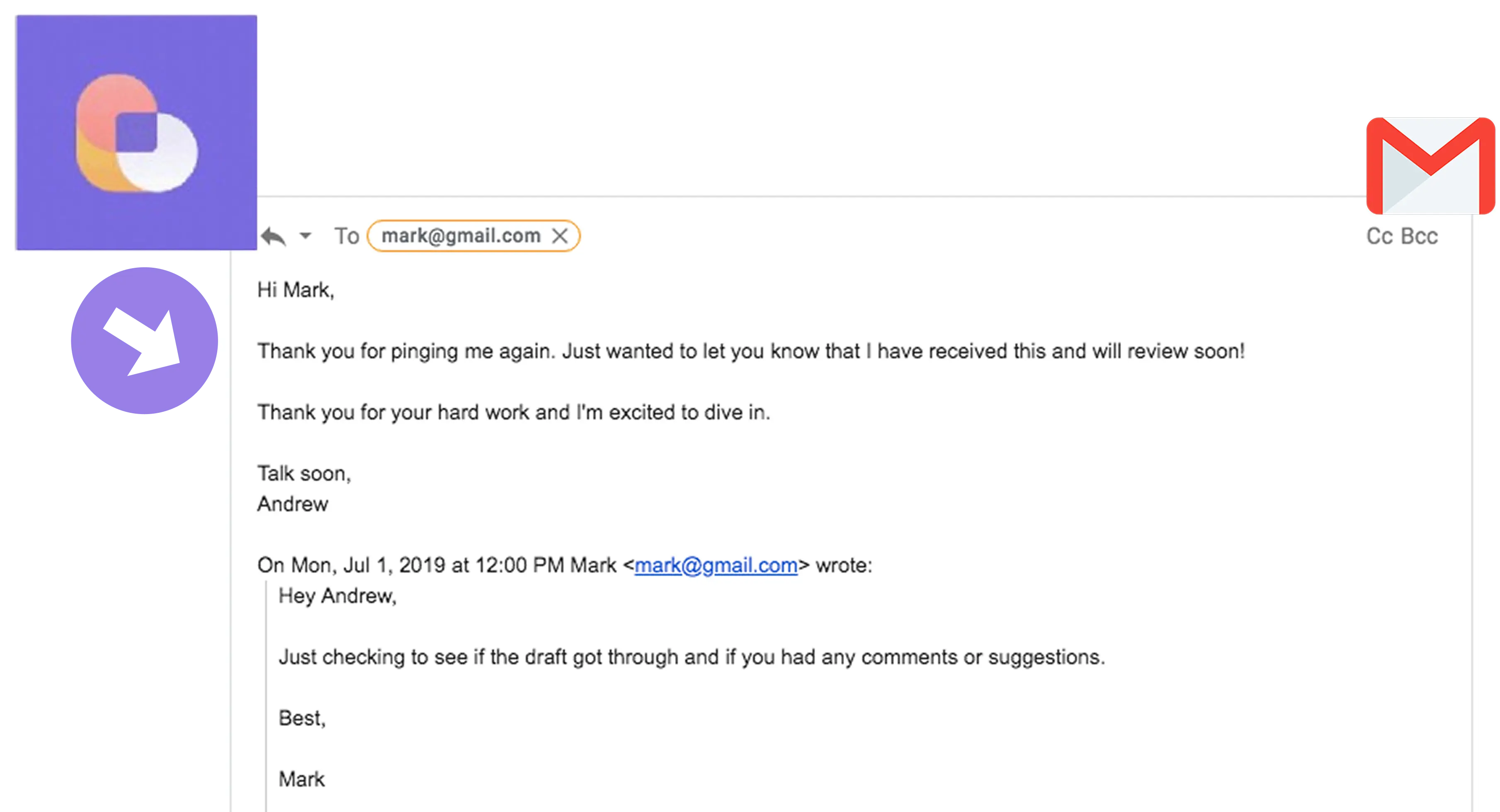
How does this playbook work?
Writing effective emails is time-consuming. This playbook uses AI to generate a personalized email draft with one click, saving time while ensuring quality.
How does this playbook work?
This playbook will analyze the last few posts from the profile and create a personalized intro message.
Tools like HubSpot and 6Sense can also analyze historical sales data to predict buying intent. For example, high-intent leads can receive targeted sales messaging, while low-intent users might be nurtured with educational content.
AI improves efficiency, but it also turns data into actionable insights. No, I’ll show you specific examples of how to use AI for B2B lead generation.
From crafting buyer personas to scaling outreach, AI for B2B lead generation is already transforming the way revenue operation teams function. Here are a few ways that AI can improve your lead-generation efforts:
In this step-by-step guide, I’ll show you exactly how to scale lead generation with the help of AI tools:
Your buyer personas are the foundation for your lead generation efforts. And if you’re going to use AI for lead generation, your personas need to be as detailed and specific as possible.
Vague definitions like this will only produce lackluster results:
❌ Marketing professionals in B2B tech
Instead, get specific. Say something like this:
✅ CMOs in B2B tech who are currently running Facebook ads, have over $10 million in revenue, have below average conversion rates, and are currently hiring.
But that level of specificity requires a level of data analysis and pattern recognition that most humans are just not capable of. Here’s how you can use AI to analyze customer data and enrich your buyer persona with extra details
Use AI tools like Gong or Salesloft to analyze sales call recordings. This will help your team identify key challenges and objections that are mentioned. You can use this data to learn more about your ideal customers and what kind of messaging speaks to them.
You can also use AI to analyze surveys and customer interviews to find out which customers are getting the most value from you. For example, automated lead enrichment can extract characteristics from customer data and create targeted audience segments.
Simply put, AI can uncover insights that may be missed by human analysis, leading to more precise, data-driven personas.
AI can analyze your CRM data from Salesforce or any other popular solution to determine which personas have the most value to your business. It can answer questions like:
Analyzing sales data in this way helps to reveal common attributes that your ideal customers share so you use this information to target better leads. It also helps to speed up the persona creation process.
AI tools can use all this data to create detailed, human-like profiles that include motivations, challenges, and preferred communication channels.
For example, knowing that your ideal customers prefer video content and are active on LinkedIn, you can create educational product videos and promote them via targeted posts. Tools like Cognism and Leadspace are amazing at this.
AI will also constantly update personas based on new customer interactions, market shifts, and sales data. This ensures that your lead generation campaigns continue to perform well as trends and habits evolve.
With AI, you can learn more about your customers than ever before. The ability to interpret data at scale means that AI-generated personas are based on real data and not influenced by assumptions and preferences.
Now that you understand the value AI-generated buyer personas can bring to your lead generation, let's explore how AI can help automate and improve lead research and qualification, ensuring you fill your pipeline with high-quality prospects.
AI is transforming the manual, time-consuming process of lead research and qualification.
By integrating AI-powered lead research into CRM systems, your team can automate sales prospecting efforts, reduce manual workload, and accelerate sales cycles in ways such as:
AI-driven platforms can even analyze engagement signals—such as email opens, website visits, and content interactions—to determine lead intent and assign a quality score. Here’s how you can use AI to enhance your team’s performance:
AI-powered tools utilize machine learning, web scraping, and natural language processing (NLP) to gather, organize, and interpret huge amounts of prospect data faster than any human can.
These tools can comb through websites, social media profiles, business directories, and CRM systems to find key details such as:
Traditionally, sales reps spend hours manually researching leads to find this kind of data. But now AI tools like Apollo can enrich lead records with additional firmographic and technographic data in a fraction of the time.
On top of basic data like industry, job title, and company size, AI can enrich your lead list with detals such as tech stack, hiring status, website analytics, recent news (such as funding secured) and other important intelligence.
Sales intelligence tools like Cognism and LeadIQ provide intent data showing which leads are actively researching solutions.
AI-driven sales prospecting tools can also validate and update lead information in real-time by cross-referencing data from multiple sources. No more chasing dead-end leads or missing key details that could make or break a deal.
Traditional lead scoring relies on manually assigned point systems, which can be biased or inaccurate. For example, sales and marketing teams often give added weight to actions like viewing a pricing page or downloading a case study. But they do this without any real evidence that these actions signal buying intent. It’s just an assumption.
Lead qualification tools improve lead scoring models by analyzing past sales data to discover what actually signals buying intent. This could even be things that manual analysis could miss like new job listings or if the company recently secured funding.
AI takes the guesswork and grunt work out of lead qualification, contributing to more reliable sales forecasts and allowing for better planning and resource allocation.
Next up, we'll explore how AI enables personalized outreach at scale, so you can turn those qualified leads into closed-won deals.
Now that your lead lists are organized by persona and lead score, it’s time to start writing some quality cold emails.
Emails that are generic and poorly targeted don’t usually perform well. Doing cold outreach this way will lead to poor engagement rates and a high spam score — which means being blocked by filters.
Research from Campaign Monitor shows that personalized email campaigns can bring in up to 760% more revenue. So if you want to improve your ROI from email marketing, creating hyper-personalized outreach is the way to go.
The problem is that manual personalization takes time and doesn’t scale well. But AI can help you reach hundreds or thousands of leads at once. Here's why:
Generic, one-size-fits-all messaging falls flat in B2B. In fact, 68% of buyers think that all B2B brands sound the same. Research also shows that personalized marketing messages receive 5X more responses than generic messages.
Buyers expect tailored outreach that speaks to their specific pain points, goals, and business context. They want to know that you understand their problem thoroughly and have a solution available. AI makes this level of personalization possible at scale.
AI writing tools can automatically generate hyper-relevant messaging by analyzing lead data. Tools like Outreach and SalesLoft create dynamic personalization by populating email templates with personalized snippets based on a lead's past behavior, preferences, pain points, and buying stage. Emails can automatically be saved as drafts where reps can review and send with a click, reaching far more leads with tailored outreach.
Other tools like Mutiny can dynamically update website content for each visitor based on firmographic data like company size, industry, and technology stack. Demandbase leverages AI to serve targeted ads and personalized web experiences to target accounts.
This approach ensures that every interaction feels relevant and timely, increasing the impact of your team's outreach.
AI uses predictive analytics to determine the best time, channel, and message format to reach each lead based on their persona. For example, a tool like Seventh Sense can tell you something like:
“Sending an email at 8 AM on Tuesday for a lead in the SaaS industry based on past engagement patterns.”
Then, you can use Exceed to optimize subject lines and message content based on conversion data.
AI-powered personalization empowers B2B teams to engage leads with the right message on the right channel at the right time - all at a scale not humanly possible. Combining automation's efficiency with personalization's impact, AI is an outreach game-changer.
Next, let's explore how to measure and optimize your AI-driven lead generation programs for maximum ROI and revenue impact.
Once you have your AI B2B lead gen engine up and running, you want to make sure your team is monitoring performance and making adjustments as needed. AI continuously learns from new data to predict trends and refine personas so you can adjust your strategies accordingly.
Here's how to leverage AI to measure and optimize your B2B lead generation:
AI-powered CRM and marketing automation tools such as HubSpot monitor the number of leads your campaigns are generating. You can then use this data to determine if you are generating enough leads to hit your sales goals.
But you already know that volume isn’t the only indicator of a successful campaign. You also want to analyze the quality of those leads and determine if they are moving toward a sale. Here are some ways that AI-powered CRMs help to assess lead quality:
AI-powered CRMs don’t just analyze this kind of data, they can even organize it into visual charts and graphs and create dashboards that your team can read at a glance.
Tools like HubSpot and LeadSquared provide teams with AI-powered insights you can use to continually hone and optimize your strategies.These tools combine AI, machine learning, and data analytics to tell you things that you might have missed manually, such as:
AI can even help you pinpoint where leads are dropping off in the funnel and suggest remedies.
One of the most powerful aspects of AI is its ability to learn and self-optimize over time. Tools like 6Sense can automatically adjust lead scoring models, fine-tune audience targeting, optimize content and messaging, and more.
For example, if AI detects that leads from a certain source or industry consistently convert at higher rates, it can automatically prioritize similar leads. Or if it finds that leads respond best to a particular subject line or content asset, it can favor those elements in future outreach.
AI empowers you to measure lead gen performance with unprecedented depth, granularity, and efficiency. By tracking key metrics, leveraging AI-powered reporting, and allowing AI to self-optimize, you can get even more ROI from your lead generation efforts.
Now that you’re properly hyped up about the possibilities of AI B2B lead generation, your head is probably spinning wondering how you are going to implement all these tools and processes.
You'll want to build out a team of AI specialists. The role of AI in B2B lead generation is still evolving so the exact roles and responsibilities your team needs will change over time.
But if you’re looking to build an AI lead generation team for your business today, you should consider the following roles:
The AI Lead Generation Specialist is a marketing or sales professional who combines data-driven strategies, AI-powered tools, and human expertise to optimize lead generation campaigns.
The Sales Development Representative (SDR) is a sales professional responsible for qualifying and nurturing leads for the sales team. SDRs typically focus on the early stages of the sales funnel before handing off to an Account Executive (AE).
The AI Copywriter/Editor is a content professional who uses AI-powered writing tools to enhance and scale content creation while maintaining strict quality controls.
And that’s a solid foundation for your AI lead generation that you can build on over time! This blend of creativity, human touch, and AI’s efficiency will help you scale your pipeline and do more with less.
Mastering AI for B2B lead generation is crucial for staying competitive and driving growth in today's digital landscape.
In this guide, you discovered how to:
Don't let your competitors outpace you in the race for B2B leads. Put these AI strategies into action and watch your lead generation soar!









SOC 2 Type II, GDPR and CASA Tier 2 and 3 certified — so you can automate with confidence at any scale.