
This automation seamlessly transfers all your contacts from Salesforce to HubSpot with minimal effort. It is designed to simplify your CRM management and ensure your contacts are synchronized across both platforms.
The process begins by retrieving all contacts from Salesforce. Once collected, these contacts are then batch created in HubSpot. This is particularly useful for:
Pro Tip: This automation can be customized to filter specific contacts or to trigger based on specific events, ensuring flexibility to meet your business needs.
By using this workflow, you can save time and reduce manual data entry errors, making it an essential tool for sales and marketing teams looking to streamline their operations.
To start, ensure you have installed the Bardeen app on your device.
After installation, proceed to the Magic Box and input the following:
Copy all Salesforce contacts to HubSpot
Make sure to integrate the necessary integrations for the workflow, which includes Salesforce for the source of contacts and HubSpot for the destination.
Now, run the workflow. This workflow is specifically designed to:
Syncing contacts from Salesforce to HubSpot is a critical task for businesses aiming to maintain consistent data across their Customer Relationship Management (CRM) and marketing platforms. This process can be performed manually, through HubSpot's native integration features, or by leveraging automation tools like Bardeen. Each method has its unique steps and considerations.
Pro Tip: Automating the sync process with Bardeen can save you time and ensure that your contacts are always up-to-date across both platforms. Start automating today.
To manually sync Salesforce contacts to HubSpot, you first need to ensure that the HubSpot-Salesforce integration is properly set up. This involves installing the HubSpot-Salesforce integration package in your Salesforce account and configuring the necessary permissions. Once the integration is in place, contacts can be synced in two primary ways: through direct import from Salesforce to HubSpot or by setting up an automatic sync that triggers when specific conditions are met.
For direct import, navigate to your HubSpot account, access the Contacts section, and select the option to import contacts from Salesforce. This method is straightforward but requires manual initiation each time you want to update your contact list in HubSpot.
For automatic syncing, you can create inclusion lists in HubSpot that define which contacts should be synced based on specific criteria. This method ensures that only relevant contacts are synced and that the data remains consistent across both platforms. Additionally, you can set up sync rules to manage how data conflicts between the two systems are resolved, ensuring data integrity.
The HubSpot-Salesforce integration allows for a seamless flow of data between the two platforms, enabling businesses to leverage the strengths of both systems effectively. This integration not only syncs contacts but also supports syncing activities, tasks, and even campaign data, providing a comprehensive view of your sales and marketing efforts.
When setting up the integration, it's crucial to understand the data architecture differences between HubSpot and Salesforce. Salesforce uses Leads and Contacts to represent people, while HubSpot uses a single Contact object. This difference requires careful mapping during the integration setup to ensure data consistency. Additionally, the integration allows for the syncing of custom objects, giving businesses flexibility in how they manage their data.
Another important aspect of the integration is the ability to sync campaign data. While HubSpot campaigns and Salesforce campaigns do not directly correspond to each other, the integration facilitates the syncing of campaign-related data, such as campaign IDs, to HubSpot contacts. This enables businesses to track the effectiveness of their marketing campaigns across both platforms.
Ready to streamline your sales and marketing efforts? Automate your Salesforce to HubSpot sync with Bardeen and focus on growing your business. Get started now.
Overall, the HubSpot-Salesforce integration is a powerful tool for businesses looking to maximize their sales and marketing efforts. By understanding the integration's capabilities and setting it up correctly, businesses can ensure that their data is consistent, up-to-date, and fully leveraged across both platforms.
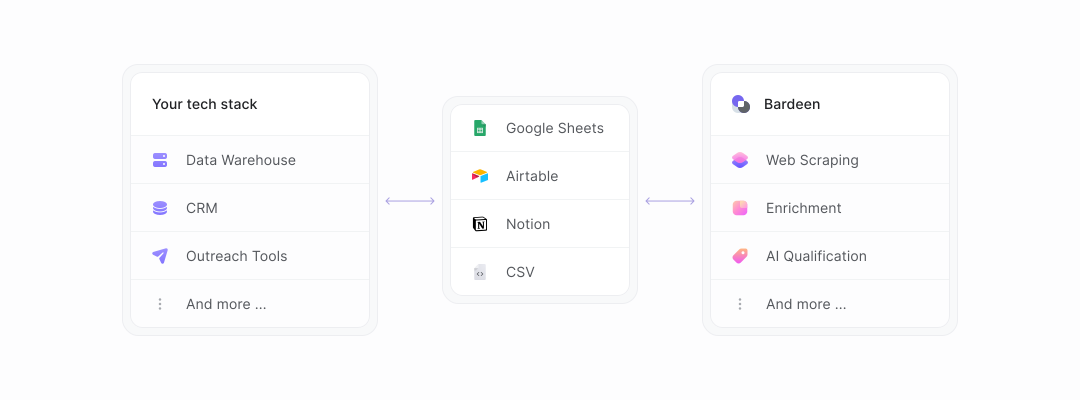
With our new Bardeen version, you can easily extract data from any website and discover new leads across the web. After extracting data from a website, use Bardeen’s powerful automation tools to validate and enrich your data, run additional scrapers on linked pages, or leverage AI to qualify leads and generate content automatically. Once your data is ready, you can easily export it to CSV, Google Sheets, Airtable, or Notion for further analysis and reporting.






SOC 2 Type II, GDPR and CASA Tier 2 and 3 certified — so you can automate with confidence at any scale.