

This automation synchronizes contacts from HubSpot to Salesforce automatically.
The process begins by retrieving contacts from HubSpot. After obtaining the list, it then creates new contacts in Salesforce using the retrieved data, including first name, last name, and email. This workflow is particularly useful for:
Pro Tip: This workflow can be customized to include additional fields based on your requirements, such as phone numbers, job titles, or company names. Additionally, conditions can be set to filter which contacts to sync.
Utilize this workflow to maintain unified and updated contact databases between HubSpot and Salesforce, enhancing your CRM strategies.
To begin, ensure you have the Bardeen app installed on your device.
After installation, proceed to the Magic Box and input the following prompt:
Get HubSpot Contacts, Create new Contacts in SalesForce
Integrate the necessary integrations for the workflow. This includes HubSpot for the source of contacts and SalesForce for the destination where new contacts will be created.
Finally, execute the workflow. This workflow is designed to:
Integrating HubSpot with Salesforce is a strategic move for businesses looking to streamline their sales and marketing efforts. This integration allows for seamless data transfer between the two platforms, ensuring that both marketing and sales teams have access to the most up-to-date information. By connecting HubSpot to Salesforce, businesses can automate the synchronization of contacts, leads, and customer information, thereby enhancing efficiency and productivity.
Automating the migration of HubSpot contacts to Salesforce can significantly improve data accuracy and save time. Consider using Bardeen to streamline this process, ensuring that your sales team always has the latest information at their fingertips.
To migrate data from HubSpot to Salesforce, you can either use the native integration available in HubSpot or opt for third-party tools that offer more customized solutions. The native integration is straightforward to set up and requires no technical expertise. It involves installing the HubSpot-Salesforce integration from the HubSpot App Marketplace, logging into your Salesforce account, and configuring the data sync settings according to your business needs.
For those requiring more control over the migration process, third-party tools and services offer advanced mapping and filtering options, allowing for a more tailored integration experience. These tools can handle complex data structures and sync custom objects, making them a viable option for businesses with specific integration requirements.
While the focus is often on migrating HubSpot contacts to Salesforce, businesses may also find value in syncing Salesforce contacts back to HubSpot. This bi-directional sync ensures that any updates made in Salesforce are reflected in HubSpot, maintaining consistency across both platforms. Setting up a two-way sync can be achieved through the same integration process, with additional configurations to specify which data points should be synced from Salesforce to HubSpot.
To maximize the benefits of the HubSpot-Salesforce integration, it's crucial to follow best practices. These include regularly reviewing and cleaning your data to prevent duplicates, setting up proper field mappings to ensure data is synced accurately, and using inclusion lists to control which contacts are synced between platforms. Additionally, leveraging automation and workflows can help streamline processes and improve the efficiency of your sales and marketing efforts.
Remember, a well-configured integration can serve as the backbone of your CRM strategy, enhancing lead management and customer engagement. Utilize Bardeen to automate repetitive tasks within this integration, freeing up valuable time for your team to focus on strategic initiatives.
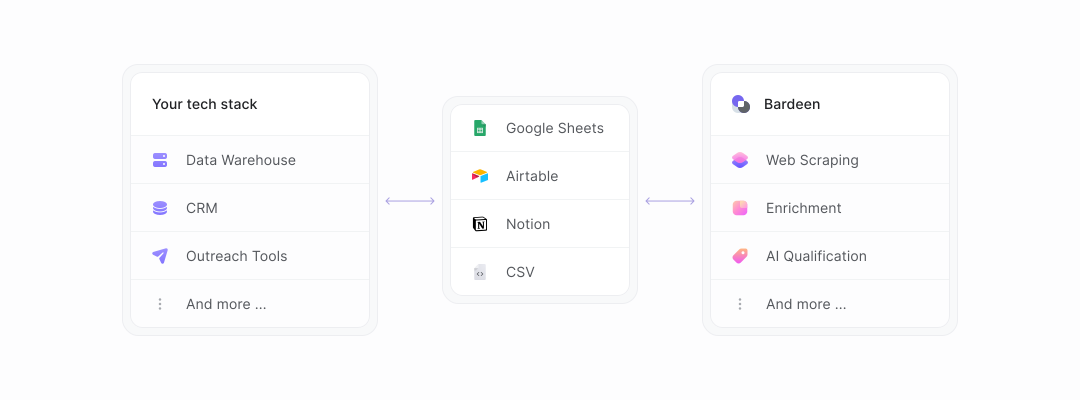
With our new Bardeen version, you can easily extract data from any website and discover new leads across the web. After extracting data from a website, use Bardeen’s powerful automation tools to validate and enrich your data, run additional scrapers on linked pages, or leverage AI to qualify leads and generate content automatically. Once your data is ready, you can easily export it to CSV, Google Sheets, Airtable, or Notion for further analysis and reporting.






SOC 2 Type II, GDPR and CASA Tier 2 and 3 certified — so you can automate with confidence at any scale.