
This automation efficiently migrates contact information from Salesforce to HubSpot, ensuring that crucial customer data is synchronized between these two powerful CRM platforms.
Initially, the automation retrieves a specific contact's information from Salesforce, including details such as first name, last name, email, phone, website, and company. Subsequently, it leverages this information to create a new contact within HubSpot, ensuring that all essential fields are accurately populated. This process is seamless and requires minimal user intervention.
Modularity: This workflow can be customized to include additional contact fields or to integrate with other CRM platforms. For instance, adding custom fields specific to your business needs or syncing contacts to other platforms like Pipedrive or Airtable is possible.
Empower your sales and marketing teams by automating the synchronization of contact information between Salesforce and HubSpot. Install Bardeen now to streamline your CRM processes.
To start, ensure you have the Bardeen app installed on your device.
Open the Bardeen app and navigate to the Magic Box. Enter the following instruction:
Export SalesForce contact, Add Contact in HubSpot
Make sure to set up integrations with both SalesForce and HubSpot. These integrations are crucial for the workflow to function properly.
After setting up, you can run the workflow. This workflow performs the following actions:
Integrating HubSpot with Salesforce is a strategic move for businesses aiming to streamline their sales and marketing efforts. This integration allows for seamless data transfer between the two platforms, ensuring that both sales and marketing teams have access to the most up-to-date information. To start the integration process, users must have the necessary permissions in both HubSpot and Salesforce accounts. The integration is initiated from the HubSpot account by navigating to the App Marketplace and selecting the Salesforce integration. Following the installation, users are guided through a series of steps to connect their Salesforce account, install the HubSpot package in Salesforce, and configure data sync settings. This setup enables data such as contacts, companies, and deals to be synchronized between HubSpot and Salesforce, enhancing collaboration between teams.
Automate the process of exporting Salesforce contacts and adding them to HubSpot with Bardeen: This workflow simplifies the task by automatically transferring contact information from Salesforce to HubSpot, ensuring data consistency across your CRM platforms. Install Bardeen now to streamline your CRM processes.
For businesses looking to migrate contacts from Salesforce to HubSpot, the process involves several steps. Initially, users should clean and organize their Salesforce data to ensure a smooth migration. This includes merging duplicates and identifying the key data to be transferred. HubSpot provides an import tool that facilitates the migration of Salesforce records, including leads, contacts, accounts, and opportunities. Users can filter the import based on specific criteria and review the import settings before beginning the process. It's important to note that only the email address of leads and contacts is synced initially, with other Salesforce field values syncing over time. By following these steps, businesses can efficiently transfer their valuable contact data from Salesforce to HubSpot, enabling them to leverage HubSpot's marketing and sales capabilities.
Switching from Salesforce to HubSpot is a decision many businesses consider to take advantage of HubSpot's user-friendly interface and comprehensive marketing tools. The transition process involves defining the data to be moved, creating new properties in HubSpot, and cleaning the data for migration. HubSpot offers resources and support to ensure a seamless migration, including a detailed comparison report and a phased approach to minimize disruptions. Businesses can expect a quick time to value, minimal disruption, and no data loss during the migration. With HubSpot's enterprise-grade CRM platform and extensive integration ecosystem, companies can scale their operations and achieve better alignment between sales and marketing teams.
Streamline your CRM integration and migration tasks with Bardeen: By automating the data transfer from Salesforce to HubSpot, Bardeen enhances efficiency and ensures data accuracy. Download Bardeen and transform your CRM management experience.
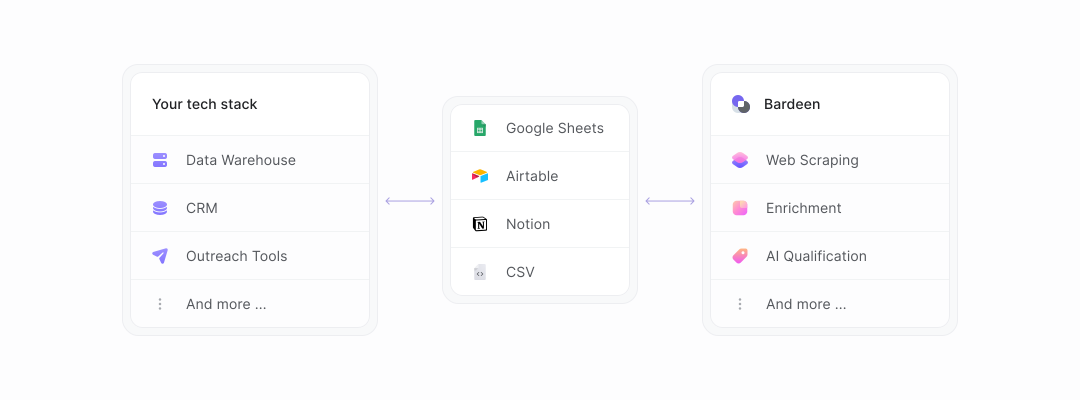
With our new Bardeen version, you can easily extract data from any website and discover new leads across the web. After extracting data from a website, use Bardeen’s powerful automation tools to validate and enrich your data, run additional scrapers on linked pages, or leverage AI to qualify leads and generate content automatically. Once your data is ready, you can easily export it to CSV, Google Sheets, Airtable, or Notion for further analysis and reporting.






SOC 2 Type II, GDPR and CASA Tier 2 and 3 certified — so you can automate with confidence at any scale.