

This workflow qualifies Salesforce leads using Bardeen AI and saves them in HubSpot, streamlining your lead management process.
It begins by retrieving a lead from Salesforce based on specified criteria. Then, Bardeen AI qualifies the lead by analyzing its description. Finally, if the lead is deemed qualified, a new contact is created in HubSpot with the lead's details. This workflow is ideal for:
Pro Tip: This workflow can be customized to fit specific lead qualification criteria and to integrate with other CRM platforms.
Implement this workflow to enhance your lead management strategy using Bardeen.
Begin by installing the Bardeen app on your device.
Open the Magic Box in the Bardeen app and input the following:
Get salesforce lead, qualify with Bardeen AI, save in HubSpot
Ensure integration with Salesforce and HubSpot is set up, as well as Bardeen AI for lead qualification.
Execute the workflow, which is designed to:
When it comes to syncing Salesforce leads and contacts to HubSpot, there are key considerations and steps to ensure a smooth and selective sync process. This involves configuring the Salesforce connector, creating inclusion lists, and understanding how data syncs between the two platforms.
Ready to streamline your lead management process? Automate the qualification and syncing of Salesforce leads to HubSpot with Bardeen. Get started now.
Initially, Salesforce leads and contacts do not automatically create records in HubSpot upon installing the Salesforce connector. They are brought into HubSpot either through manual import or when a sync is triggered. It's crucial to note that all HubSpot contacts will sync to Salesforce by default. However, by creating an inclusion list in HubSpot, you can specify that only contacts meeting certain criteria will sync. This selective sync ensures that only relevant data is shared between the platforms, maintaining data integrity and relevance.
To manage this selective sync effectively, understanding the default field mappings and the possibility of creating custom field mappings is essential. This allows for a tailored sync process that aligns with your specific business needs. Additionally, Salesforce deduplication practices play a critical role in ensuring that records are accurately synced without creating duplicates.
Creating a Salesforce inclusion list is a critical step in managing which contacts sync from HubSpot to Salesforce. This process involves selecting an existing active list or creating a new one within HubSpot's sync settings for Salesforce. The inclusion list acts as a filter, allowing only the contacts that meet your specified criteria to be synced with Salesforce.
When setting up or editing your inclusion list, it's important to define clear criteria that determine which contacts should be included. This might involve selecting contacts based on their lifecycle stage, engagement level, or any other relevant criteria that align with your sales and marketing strategies.
Once your inclusion list is configured, it's essential to understand that members of this list will only sync with Salesforce when a sync is triggered. This means that any new or updated contacts that meet the inclusion list criteria will be synced accordingly, ensuring that your Salesforce database remains up-to-date with the most relevant and qualified leads from HubSpot.
Maximize your lead management efficiency by automating the sync process with Bardeen. Try it today and see the difference in your workflow.
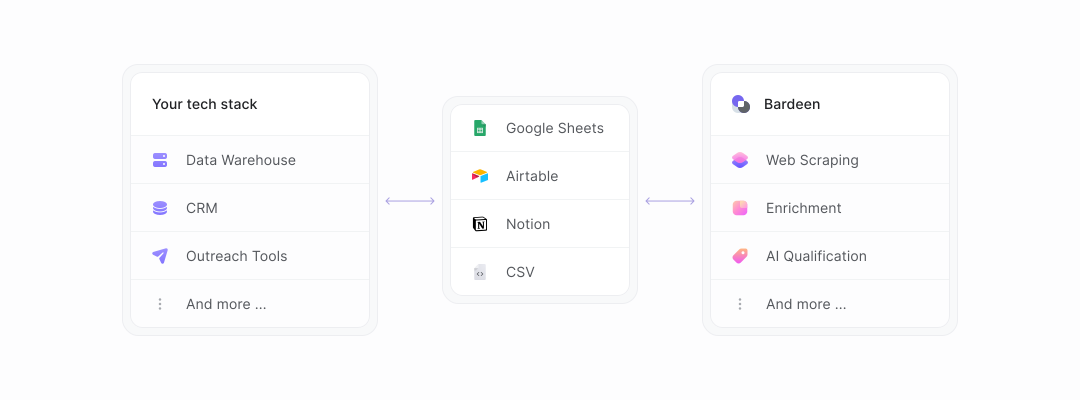
With our new Bardeen version, you can easily extract data from any website and discover new leads across the web. After extracting data from a website, use Bardeen’s powerful automation tools to validate and enrich your data, run additional scrapers on linked pages, or leverage AI to qualify leads and generate content automatically. Once your data is ready, you can easily export it to CSV, Google Sheets, Airtable, or Notion for further analysis and reporting.






SOC 2 Type II, GDPR and CASA Tier 2 and 3 certified — so you can automate with confidence at any scale.