

This automation scrapes an article from a webpage and summarizes its content into a text file. It's a powerful tool for efficiently condensing information and making it more accessible.
The process begins by fetching the HTML content of a specified webpage. Then, it extracts the main article text. Utilizing OpenAI's advanced models, it summarizes this article. Finally, this summarized text is downloaded as a text file. This workflow is perfect for:
Note: This workflow can be adapted to scrape and summarize multiple articles by iterating over a list of URLs. Additionally, the summary's complexity can be adjusted by changing the OpenAI model's temperature parameter.
Streamline your content curation and research process by utilizing this automation with Bardeen.
Begin by installing the Bardeen app on your device.
After installation, open the Magic Box and input the following prompt:
Scrape article text from a webpage and use OpenAI to summarize it into a text file.
Make sure to configure the necessary integrations for the workflow. This includes Scraper for fetching and extracting article content, and OpenAI for summarizing the article text.
Finally, execute the workflow. This workflow is programmed to:
Efficiency and clarity are paramount in today's information-saturated world. Whether you're a student, researcher, content creator, or just someone trying to stay informed, the ability to quickly condense lengthy articles into digestible summaries is invaluable. With advancements in AI, summarizing articles has become more accessible and efficient, allowing users to focus on the essence without getting bogged down by details. Summarization tools and techniques, particularly those utilizing AI like ChatGPT, have revolutionized how we process information, making it easier to capture the core insights of extensive texts.
Streamline your content curation and research process by utilizing AI-powered summarization tools. Start summarizing now.
Tools such as TLDR This and Semrush's AI summarizing tool have emerged to serve various users, from students to professionals, by offering concise summaries of texts and articles. These tools highlight the most relevant points, filtering out fluff and providing quick, actionable insights. Moreover, they often come with features like metadata extraction, which includes author details and estimated reading time, enhancing the overall reading experience by offering a distraction-free environment.
For those preferring a more hands-on approach or seeking customization in their summaries, ChatGPT offers a powerful alternative. Summarizing articles with ChatGPT involves copying the text you wish to summarize and pasting it into ChatGPT's interface, then prompting the AI to condense the content. This method provides flexibility in summary length and focus, accommodating specific requests such as concentrating on particular aspects of the article or adjusting the summary's complexity.
Here are the steps to summarize an article manually with ChatGPT:
While this method offers customization, it's essential to be aware of ChatGPT's limitations, such as token limits that might affect summarizing lengthy documents and the accuracy of the generated summaries. Users should fact-check and refine the summaries as needed.
Looking to save time and enhance your productivity? Automate your article summarization with Bardeen. Get started here.
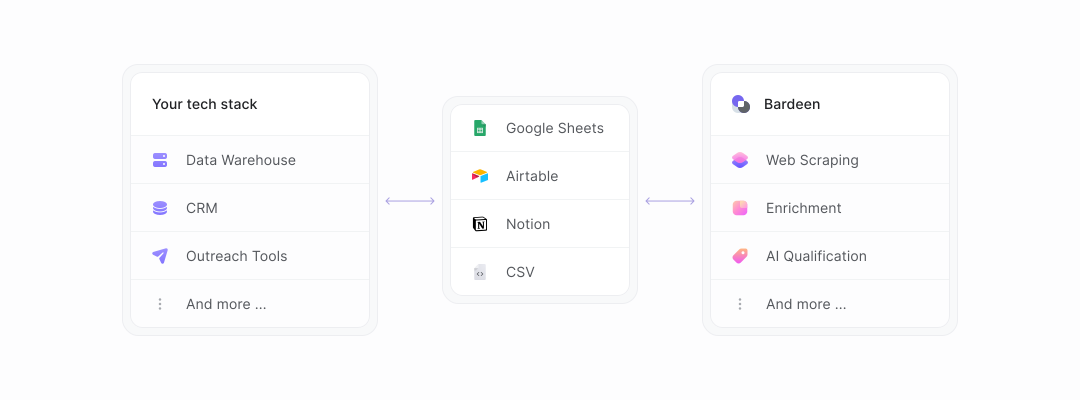
With our new Bardeen version, you can easily extract data from any website and discover new leads across the web. After extracting data from a website, use Bardeen’s powerful automation tools to validate and enrich your data, run additional scrapers on linked pages, or leverage AI to qualify leads and generate content automatically. Once your data is ready, you can easily export it to CSV, Google Sheets, Airtable, or Notion for further analysis and reporting.






SOC 2 Type II, GDPR and CASA Tier 2 and 3 certified — so you can automate with confidence at any scale.