This automation creates a new Salesforce lead when a specific label is added to an email in your inbox. It's a seamless way to convert potential leads from your email directly into Salesforce without manual data entry.
When an email is labeled (e.g., "Potential Lead"), the automation triggers and captures the necessary details such as the sender's first name, last name, company, and email. These details are then used to create a new lead in Salesforce. This can be particularly useful for:
Note: This workflow can be customized to include additional lead information or to trigger based on different email actions.
Automating the lead capture process ensures that no potential lead is missed and allows sales teams to act quickly. Install Bardeen to streamline your lead management process.
To start, ensure the Bardeen app is installed on your device.
After installation, go to the Magic Box and input:
Create a new Salesforce lead when a label is added to an email
Set up the required integrations for the workflow. This involves linking Google Mail for email management and Salesforce for CRM functionalities.
Lastly, execute the workflow. This workflow is structured to:
Converting email interactions into Salesforce leads is a crucial process for businesses looking to streamline their lead generation and management processes. This process involves capturing key information from emails and using it to create new lead records in Salesforce, a leading customer relationship management (CRM) platform. By automating this process, businesses can ensure that no potential lead is missed and that sales teams can act quickly on new opportunities.
Ready to automate your lead management process? Install Bardeen to streamline your lead management process.
Integrating email services with Salesforce allows for the seamless conversion of email inquiries into leads. This integration not only saves time but also ensures accuracy in capturing lead information. Salesforce offers various methods to facilitate this integration, including Salesforce Flow, Email Services, and third-party apps available on the Salesforce AppExchange. Each method has its unique setup and benefits, catering to different business needs and technical capabilities.
Creating an email to lead process in Salesforce can be achieved through Salesforce Flow, a powerful tool provided by Salesforce for automating business processes without the need for coding. Salesforce Flow allows users to define triggers and actions, such as creating a new lead when an email is received with specific criteria. The process involves setting up an email service that forwards emails to a Salesforce-generated email address, which then triggers the Flow to create a lead based on the email content.
For businesses with more specific needs or looking for a more straightforward setup, Salesforce offers integration with email services like Gmail and Outlook. This integration enables sales teams to work within their email clients while simultaneously logging emails and creating leads in Salesforce. Additionally, third-party apps from the Salesforce AppExchange can provide more customized solutions for email to lead conversion, offering features like advanced parsing to extract detailed information from emails.
Regardless of the method chosen, integrating email with Salesforce for lead creation involves careful consideration of the business's specific needs and workflows. It's essential to select a solution that not only automates the process but also aligns with the sales team's practices to ensure the efficient and effective management of new leads.
Streamline your lead capture process with Bardeen. Get started now and never miss a potential lead.
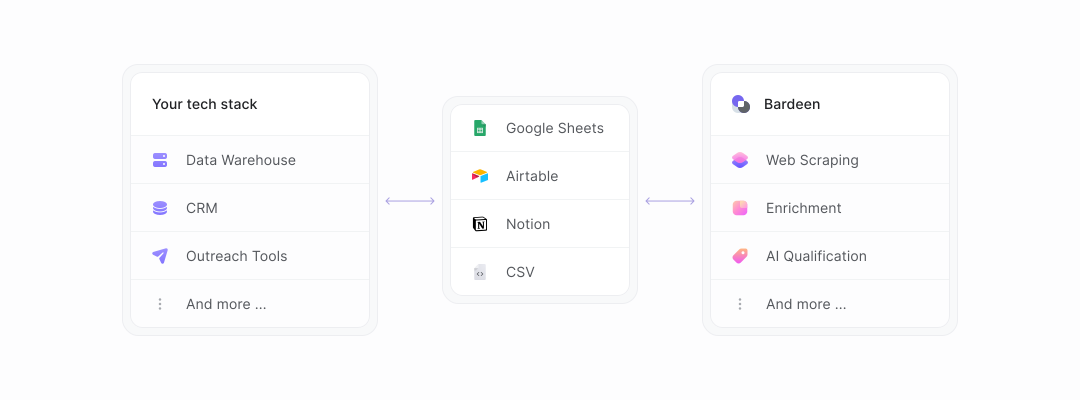
With our new Bardeen version, you can easily extract data from any website and discover new leads across the web. After extracting data from a website, use Bardeen’s powerful automation tools to validate and enrich your data, run additional scrapers on linked pages, or leverage AI to qualify leads and generate content automatically. Once your data is ready, you can easily export it to CSV, Google Sheets, Airtable, or Notion for further analysis and reporting.






SOC 2 Type II, GDPR and CASA Tier 2 and 3 certified — so you can automate with confidence at any scale.