how to import rss feed to google sheets step by step

TLDR

Use IMPORTFEED to pull RSS data into Google Sheets.

By the way, we're Bardeen, we build a free AI Agent for doing repetitive tasks.

If you need to automate data imports, check out our AI automation tools. It helps you save time by automating repetitive tasks like data aggregation from RSS feeds.

Import RSS Feed into Google Sheets

Importing an RSS feed into Google Sheets allows you to automatically pull data from various websites directly into a spreadsheet. This can be particularly useful for tracking updates, news, or any other data that is provided through an RSS feed. Google Sheets provides a built-in function called IMPORTFEED for this purpose.

Automate your data aggregation from RSS to Google Sheets with Bardeen and save time on manual entry.

__wf_reserved_inherit

Using IMPORTFEED Function

The IMPORTFEED function in Google Sheets is designed to fetch data from RSS or ATOM feeds. The basic syntax of the function is:

'IMPORTFEED(url, [query], [headers], [num_items])'

Here's a breakdown of the parameters:

  • url: The URL of the RSS or ATOM feed. It must be enclosed in quotation marks or be a reference to a cell containing the URL.
  • query (optional): Specifies the data to fetch from the URL. It can be "items" for the full table, "feed" for feed information, or specific attributes like "items title" for just the titles.
  • headers (optional): Indicates whether to include column headers. Set to FALSE by default.
  • num_items (optional): The number of items to return, starting from the most recent. If not specified, all items are returned.

Examples of usage include:

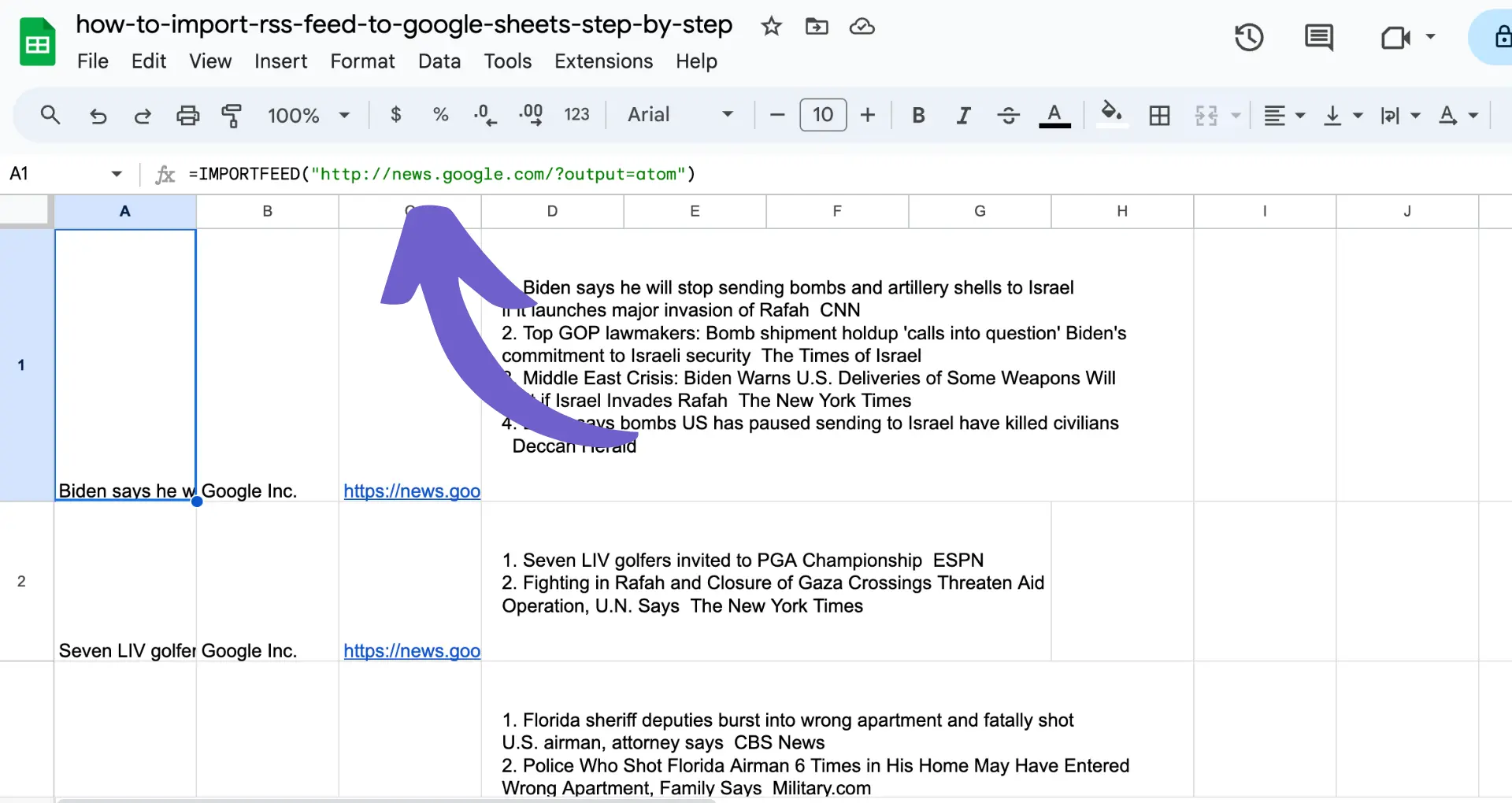
'IMPORTFEED("http://news.google.com/?output=atom")'

__wf_reserved_inherit

This formula fetches data from the specified RSS feed. To fetch a specific number of items or to include headers, you can adjust the formula accordingly.

Discover how to enhance your Google Sheets with powerful addons through our detailed blog post on Google Sheets addons.

Create RSS Feed from Google Sheets

While Google Sheets excels at consuming data from RSS feeds, creating an RSS feed from Google Sheets data is not directly supported. However, there are workarounds:

  • Using Google Apps Script to format the data in a Google Sheet as XML and then publishing the sheet to the web as a .tsv file. This method requires some scripting knowledge.
  • Utilizing third-party services like to create an RSS feed from new Google Sheets spreadsheet rows. This approach is more user-friendly and doesn't require coding skills.

For the second method, you can set up triggers whenever a new row is added to your spreadsheet, and then automatically adds this data to your RSS feed. This allows for easy publishing and sharing of data from Google Sheets.

Learn how to automate your Google Sheets for maximum efficiency in our insightful post about Google Sheet Automations.
__wf_reserved_inherit

Common Limitations and Considerations

When using the IMPORTFEED function, be aware of some common limitations:

  • Invalid or inaccessible URLs will result in errors.
  • Some feeds may require authentication or be blocked by security settings.
  • Feeds that are not updated or are in unsupported formats may not work.
  • There's a limit to the amount of data that can be imported at one time.

For creating RSS feeds from Google Sheets, consider the maintenance and update frequency of your data, as well as the privacy implications of making your data publicly accessible.

More articles

"Our Sales and Ops teams can do more in less time to help serve our customers better."

Alex Bouaziz
Co-Founder & CEO at deel.
Enterprise-grade security

SOC 2 Type II, GDPR and CASA Tier 2 and 3 certified — so you can automate with confidence at any scale.


Frequently asked questions

What is Bardeen?
What tools does Bardeen replace for me?
Who benefits the most from using Bardeen?
How does Bardeen integrate with existing tools and systems?
What are common use cases I can accomplish with Bardeen?
By clicking “Accept”, you agree to the storing of cookies. View our Privacy Policy for more information.