

This automation seamlessly transfers contact information from HubSpot to Salesforce, ensuring your sales team has up-to-date information across platforms.
The process starts by retrieving contact details from HubSpot using the contact ID. It then creates or updates a contact in Salesforce with the retrieved information, including first name, last name, email, phone, and company. This automation is perfect for sales teams looking to:
Note: This workflow requires access to both HubSpot and Salesforce. The automation can be customized to include additional fields as needed.
Streamline your sales process by automating the transfer of contact information between HubSpot and Salesforce with Bardeen.
Start by installing the Bardeen app on your device to access its features.
Open the Bardeen app and navigate to the Magic Box. Here, input the following prompt:
copy and save a HubSpot contact as a new contact in Salesforce
Ensure that HubSpot and Salesforce integrations are properly set up in Bardeen. These integrations are essential for accessing and transferring contact information.
With everything set up, run the workflow. This workflow performs the following tasks:
Integrating HubSpot with Salesforce facilitates a seamless flow of data between marketing and sales teams, enhancing lead management, and ensuring that both teams have access to up-to-date contact information. This integration allows for the automatic transfer of contact details from HubSpot to Salesforce, thereby eliminating manual data entry and ensuring data consistency across platforms. By automating this process, businesses can save time, reduce errors, and improve their overall sales and marketing efficiency.
Streamline your sales and marketing efforts by automating the transfer of contact information from HubSpot to Salesforce with Bardeen. Try it now!
Before diving into the details of copying and saving a HubSpot contact as a new contact in Salesforce, it's crucial to have the HubSpot-Salesforce integration properly set up. The process begins in your HubSpot account, where you'll navigate to the marketplace to find and install the Salesforce integration app. This step involves logging into Salesforce within the HubSpot interface to establish the connection between the two platforms.
Once the Salesforce integration package is installed, you'll be prompted to configure your data sync preferences, field mappings, and other settings to ensure that the data flows correctly between HubSpot and Salesforce. This includes deciding which contacts to sync, setting up activity and task sync settings, and configuring object and property sync settings. After finalizing these settings, the integration will be active, and data will start syncing between HubSpot and Salesforce.
With the integration set up, the process of copying and saving a HubSpot contact as a new contact in Salesforce becomes automated. When a new contact is created or updated in HubSpot, the integration automatically syncs this information to Salesforce, either creating a new contact or updating an existing one based on the configured sync settings. This ensures that your Salesforce CRM is always up-to-date with the latest contact information from your HubSpot marketing campaigns.
For businesses with more complex needs, such as syncing custom objects or managing intricate data relationships, the integration offers advanced settings and capabilities. Enterprise users can sync custom objects and manage relationships between standard and custom objects, providing flexibility to handle various data synchronization scenarios. However, it's important to review and adjust the field mappings and sync settings regularly to ensure data integrity and accuracy.
Enhance your team's productivity and ensure data accuracy by automating the HubSpot to Salesforce contact sync with Bardeen. Get started today!
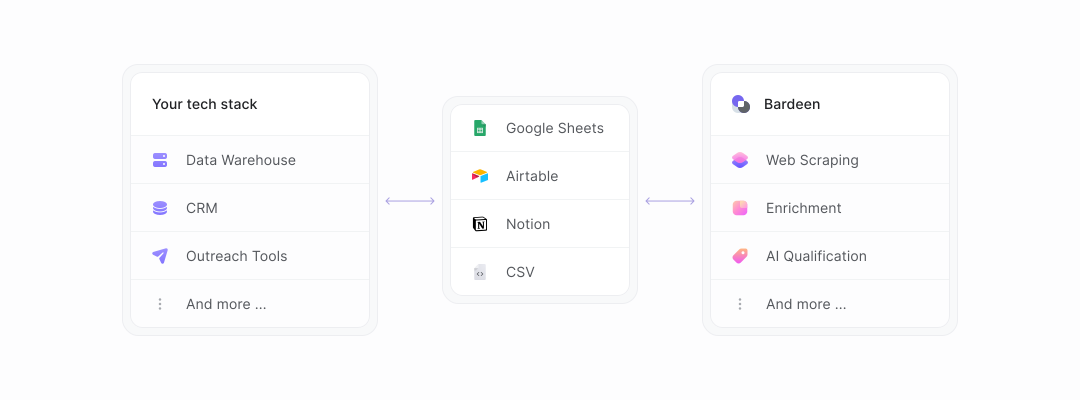
With our new Bardeen version, you can easily extract data from any website and discover new leads across the web. After extracting data from a website, use Bardeen’s powerful automation tools to validate and enrich your data, run additional scrapers on linked pages, or leverage AI to qualify leads and generate content automatically. Once your data is ready, you can easily export it to CSV, Google Sheets, Airtable, or Notion for further analysis and reporting.






SOC 2 Type II, GDPR and CASA Tier 2 and 3 certified — so you can automate with confidence at any scale.