

This automation scrapes product data from an Amazon product page and saves it to a specified Google Sheet. Utilizing a sophisticated combined scraper model, it extracts detailed product information, including titles, prices, ratings, and more, directly from the active tab displaying an Amazon product.
The workflow is initiated by scraping product data from the Amazon page you are currently viewing. Following this, it automatically appends the extracted data into your chosen Google Sheet. This is particularly useful for:
Pro Tip: Customize the scraper model or the sheet format according to your specific needs.
Adopt this workflow for seamless integration of web-scraped data into your data analysis tools. Perfect for businesses and individuals looking to automate their data collection from Amazon.
To get started, ensure the Bardeen app is installed on your device.
Open the Magic Box in the Bardeen app and input the following prompt:
Scrape Amazon Product Data then save into Google Sheets
Make sure to integrate the integrations required for the workflow, specifically the Scraper for Amazon product data and Google Sheets for saving the data.
Proceed to run the workflow. This workflow is configured to:
Scraping Amazon for product data is a process that involves extracting information such as product names, prices, ratings, and descriptions from Amazon's website. This can be particularly useful for market research, competitor analysis, or tracking price changes. While Amazon's vast database of products offers valuable data, extracting this information manually can be time-consuming and inefficient. Therefore, automating this process using web scraping techniques or tools can significantly enhance productivity and data accuracy.
Ready to automate your Amazon product data scraping and save it directly into Google Sheets? Try this workflow with Bardeen: Start Automating
For those looking to scrape Amazon product data manually, Python is a popular choice due to its powerful libraries. The process involves sending HTTP requests to Amazon's website, preferably using custom headers to mimic a browser request, and parsing the HTML response to extract the needed data. Libraries such as Requests and Beautiful Soup are essential for fetching and parsing the webpage, respectively. However, this method requires programming knowledge and can be blocked by Amazon's anti-scraping mechanisms.
Another approach involves using no-code tools or browser extensions designed for web scraping, which can simplify the process for users without a programming background. These tools allow users to select the data they wish to scrape directly from the website using a point-and-click interface and save the extracted data into formats like CSV or directly into Google Sheets.
Regardless of the method, it's important to be aware of Amazon's terms of service regarding web scraping and to use these techniques responsibly to avoid any potential legal issues or being blocked by Amazon.
Once you have scraped Amazon product data, the next step is to import this data into Google Sheets for analysis or monitoring. This can be done manually by saving the scraped data as a CSV file and then importing it into Google Sheets. However, this method lacks efficiency, especially if you need to update the data regularly.
An automated solution involves using web scraping tools or add-ons that directly integrate with Google Sheets. These tools can extract data from Amazon and append it directly into a specified Google Sheet in real-time. This not only saves time but also ensures that your data is always up-to-date. For instance, using a tool like ImportFromWeb, you can set up a function in Google Sheets to pull data directly from Amazon using specific selectors for product details such as price, rating, and description.
Automate the process of importing Amazon product data into Google Sheets for real-time updates and analysis. Explore how Bardeen can streamline your workflow: Learn More
For more advanced users, Google Apps Script can be used to create custom functions for importing data into Google Sheets. This method offers flexibility and can be customized to fit specific requirements, such as filtering data or setting up automatic refresh intervals. However, it requires some programming knowledge and familiarity with Google Apps Script.
In conclusion, while manual methods exist for scraping Amazon product data and importing it into Google Sheets, automating these processes can significantly increase efficiency and accuracy. Tools and add-ons that integrate directly with Google Sheets offer a convenient and powerful way to keep track of Amazon product data for various purposes.
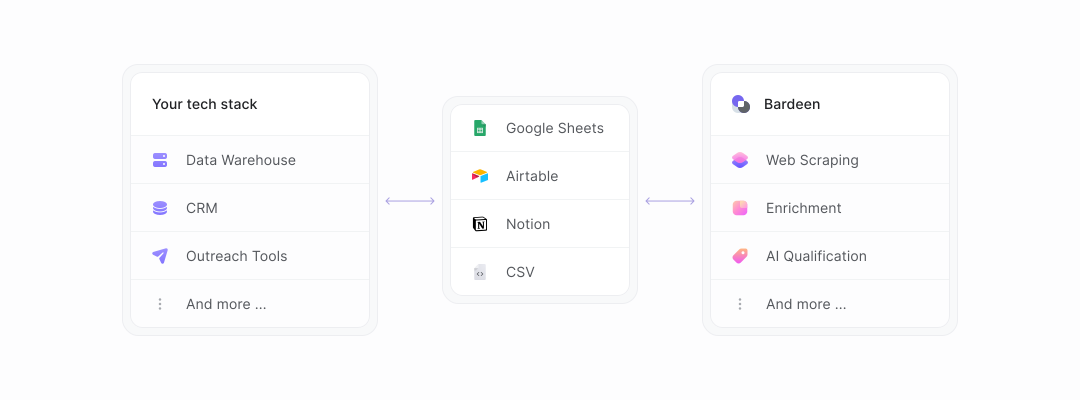
With our new Bardeen version, you can easily extract data from any website and discover new leads across the web. After extracting data from a website, use Bardeen’s powerful automation tools to validate and enrich your data, run additional scrapers on linked pages, or leverage AI to qualify leads and generate content automatically. Once your data is ready, you can easily export it to CSV, Google Sheets, Airtable, or Notion for further analysis and reporting.






SOC 2 Type II, GDPR and CASA Tier 2 and 3 certified — so you can automate with confidence at any scale.