
This automation extracts lead data from Google Maps and directly saves it into a Google Sheet. It uses a goal-driven approach to scrape information such as Business Name, Address, Phone Number, and Website based on a specified search goal.
The process begins by scraping leads data from Google Maps according to the defined goal. It operates in the background, even in incognito mode for privacy, attempting up to 5 times to ensure accuracy and completeness. After the data is successfully scraped, it is then appended into the designated Google Sheet.
Note: This automation is highly adaptable for various use cases, including market research, lead generation, and competitive analysis. The goal can be adjusted to target different types of businesses or locations as needed.
With Bardeen, this workflow simplifies the process of gathering and organizing lead information, making it an invaluable tool for sales and marketing professionals.
To start, ensure the Bardeen app is installed on your device.
Open the Bardeen app and head over to the Magic Box. Input the following prompt:
Scrape Google Maps for Leads then save into Google Sheets
For the workflow to function, you need to set up integrations with Google Maps for scraping leads and Google Sheets for saving the data.
After setup, execute the workflow. This process will:
Scraping Google Maps for leads is a powerful technique for businesses and marketers to gather valuable data about potential clients. This data can include business names, addresses, phone numbers, websites, and more. While there are several methods and tools available for scraping Google Maps, it's essential to choose an approach that meets your specific needs without violating Google's terms of service.
Ready to streamline your lead generation process? Automate the task with Bardeen. Start now.
Manual data extraction from Google Maps can be time-consuming but is a straightforward way to collect information for a small number of leads. For larger scale operations, utilizing web scraping tools or Google Maps APIs, with attention to their limitations and costs, can be more efficient. Always consider the ethical implications and legalities of scraping data from Google Maps to ensure compliance with Google's policies.
When it comes to Google Maps data scraping, there are a few key methods to consider. The first method involves using the Google Maps API, which provides a legitimate way to access Google Maps data. However, it's important to note that the API is not free, and there are costs associated with extensive use. Another method is to employ web scraping tools, which can automate the process of extracting data from Google Maps. Tools like Beautiful Soup and Scrapy are popular choices among developers for this purpose.
For those looking for a more straightforward solution, extensions and tools specifically designed for scraping Google Maps, such as Maps Scraper & Leads Extractor, can be incredibly useful. These tools allow users to efficiently search for businesses on Google Maps and extract pertinent information, which can then be exported to formats like Excel or CSV for further analysis.
Transferring data from Google Maps to Google Sheets is a valuable skill for organizing and analyzing lead information. One method to achieve this is by manually copying and pasting the data from Google Maps into a Google Sheets document. While this method is simple, it can be labor-intensive for larger datasets.
An alternative approach involves using Google Maps formulas within Google Sheets, which can calculate distances, travel times, and even perform reverse geocoding. This method requires no sign-up for the Google Maps API and can be a quick way to manipulate Google Maps data directly within Google Sheets. For those with coding skills, custom Google Maps functions can be written in Google Sheets to automate various tasks, such as calculating distances or fetching GPS coordinates.
Using a Google Maps leads extractor is an effective way to automate the process of gathering lead information from Google Maps. Tools like Maps Scraper & Leads Extractor offer a user-friendly interface that allows marketers and sales teams to search for businesses and extract key details such as names, addresses, phone numbers, and social media profiles. These tools often provide the option to export the data to Excel or CSV, making it easier to integrate with other marketing and sales tools.
Enhance your productivity and lead generation efforts with Bardeen. Automate your Google Maps scraping process and save valuable time. Try Bardeen now.
Regardless of the method chosen, it's crucial to respect Google's terms of service and the privacy of the data being scraped. Ethical considerations should always be at the forefront of any data scraping activity to avoid legal issues and maintain the integrity of your business practices.
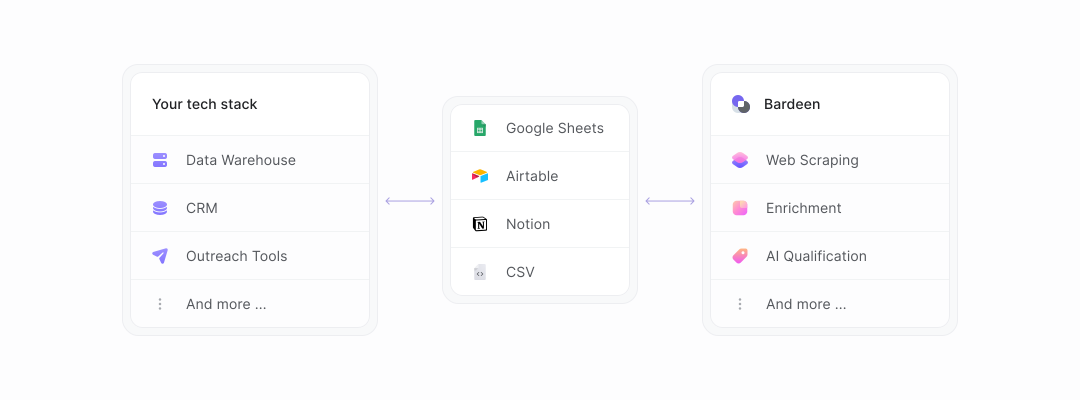
With our new Bardeen version, you can easily extract data from any website and discover new leads across the web. After extracting data from a website, use Bardeen’s powerful automation tools to validate and enrich your data, run additional scrapers on linked pages, or leverage AI to qualify leads and generate content automatically. Once your data is ready, you can easily export it to CSV, Google Sheets, Airtable, or Notion for further analysis and reporting.






SOC 2 Type II, GDPR and CASA Tier 2 and 3 certified — so you can automate with confidence at any scale.