

This workflow scrapes interview data from Glassdoor and saves it into a specified Google Sheets document. It leverages a combined scraper model to extract detailed interview information directly from the active Glassdoor page you are viewing.
Firstly, the workflow activates the scraper model on the active tab where Glassdoor interviews are displayed. Once the data is scraped, it is then appended into the designated Google Sheets document, organizing the interview details neatly in your spreadsheet. This workflow is particularly useful for:
Note: You can customize the scraper model to extract specific data points according to your needs. Additionally, the target Google Sheets document can be part of a larger dataset where further analysis can be conducted.
Streamline your data collection and analysis process by automating the scraping of valuable interview insights from Glassdoor directly into Google Sheets with Bardeen.
To start, ensure the Bardeen app is installed on your device.
Open the Bardeen app and go to the Magic Box. Enter the following prompt:
scrape interviews from Glassdoor, save into google sheets
Set up the required integrations for the workflow. This includes the Scraper for sourcing data from Glassdoor and Google Sheets for storing the scraped data.
Now, execute the workflow. It is programmed to:
Scraping Glassdoor involves extracting data from the Glassdoor website, which can include company information, job listings, reviews, and interviews. This data is valuable for various purposes, such as market research, sentiment analysis, and job market trends. However, scraping Glassdoor presents challenges due to its dynamic content, legal considerations, and technical barriers like login overlays and region-specific content.
Automate your Glassdoor data collection with Bardeen. Simplify the process and save time. Start now.
Manually scraping Glassdoor data requires programming knowledge, specifically in Python, and familiarity with web scraping libraries such as BeautifulSoup and Selenium. The process involves setting up the environment, handling login overlays using JavaScript or browser tools, selecting the correct region for relevant data, and navigating through pagination. Tools like BeautifulSoup help parse HTML content to extract necessary data, while Selenium automates browser interactions to access dynamic content. It's crucial to respect Glassdoor's terms of use and legal restrictions to avoid legal issues and ensure ethical scraping practices.
For those without coding expertise, web scraping tools like Octoparse, Parsehub, and WebHarvy offer a no-code solution for extracting Glassdoor data. These tools provide a user-friendly interface to select data for scraping and export the data to formats like Excel or CSV. However, the effectiveness of these tools can vary based on the website's structure and the complexity of the data being extracted.
Streamline your Glassdoor data extraction with Bardeen. Experience hassle-free automation and enhance your data analysis. Try it now.
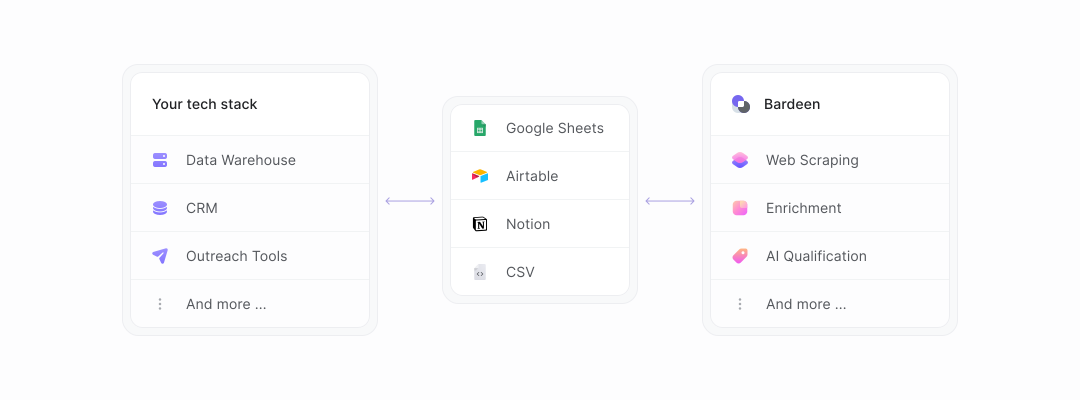
With our new Bardeen version, you can easily extract data from any website and discover new leads across the web. After extracting data from a website, use Bardeen’s powerful automation tools to validate and enrich your data, run additional scrapers on linked pages, or leverage AI to qualify leads and generate content automatically. Once your data is ready, you can easily export it to CSV, Google Sheets, Airtable, or Notion for further analysis and reporting.






SOC 2 Type II, GDPR and CASA Tier 2 and 3 certified — so you can automate with confidence at any scale.