

This automation streamlines the process of scraping Amazon product prices and saving them directly into a Google Sheets tab.
First, it activates on the current browser tab where an Amazon product page is open. Using a pre-defined scraper model named "AmazonPrices", it extracts the prices of the product. Then, these prices are automatically appended to a specified Google Sheet, allowing you to easily track price changes or compare prices across different products.
Note: This workflow is adaptable to various scraper models for different types of data extraction from Amazon or other e-commerce sites.
This automation is particularly useful for e-commerce analysts, price comparison services, or anyone needing up-to-date pricing information from Amazon.
Begin by downloading and installing the Bardeen app.
Open the Bardeen app and go to the Magic Box. Input the prompt:
Scrape Amazon Prices then save into Google Sheets
Ensure the Scraper for Amazon and Google Sheets integrations are set up in Bardeen.
Execute the workflow with the following operations:
Scraping Amazon for product prices is a task that can significantly benefit e-commerce analysts, price comparison services, or anyone needing up-to-date pricing information. While there are manual methods to collect this data, automating the process can save a considerable amount of time and effort. This guide will explore how to manually scrape Amazon prices and then introduce a more efficient method using Bardeen to automate the process and directly save the data into Google Sheets.
Looking to streamline your Amazon price tracking? Automate the process with Bardeen and save directly to Google Sheets. Try it now!
Manually scraping Amazon involves inspecting the webpage of the product for which you want to collect pricing data. This can be done by right-clicking on the product page and selecting "Inspect" to view the page's HTML source code. You'll need to locate the specific HTML elements that contain the product's price, title, and any other relevant information you wish to scrape. This process requires a basic understanding of HTML and possibly some trial and error to identify the correct elements.
Once identified, you can use Python libraries such as BeautifulSoup and Requests to write a script that makes a request to the Amazon product page, parses the HTML to extract the needed data, and then saves this data in a desired format. However, this method has its limitations, including the need for programming knowledge and the potential for your IP address to be blocked by Amazon for making automated requests.
For those looking for a no-code solution that bypasses the complexities of manual scraping and programming, automating the process with Bardeen presents a seamless alternative. Bardeen's automation allows you to scrape Amazon product prices and directly import them into Google Sheets without writing a single line of code. This method not only simplifies the data collection process but also enables you to easily track price changes over time in a familiar spreadsheet format.
To use this automation, you would typically start by installing the Bardeen extension, navigating to the Amazon product page of interest, and then running the pre-defined "AmazonPrices" scraper model. The extracted prices are then automatically appended to a specified Google Sheet. This process can be customized to fit various scraper models for different types of data extraction, not just from Amazon but from other e-commerce sites as well.
Tracking Amazon prices in Google Sheets using Bardeen not only saves time but also allows for easy sharing and analysis of the collected data. You can set up the automation to run at specific intervals, ensuring you always have the most current pricing information at your fingertips.
Maximize efficiency and accuracy in tracking Amazon prices by automating the process with Bardeen. Save your valuable time and get started here.
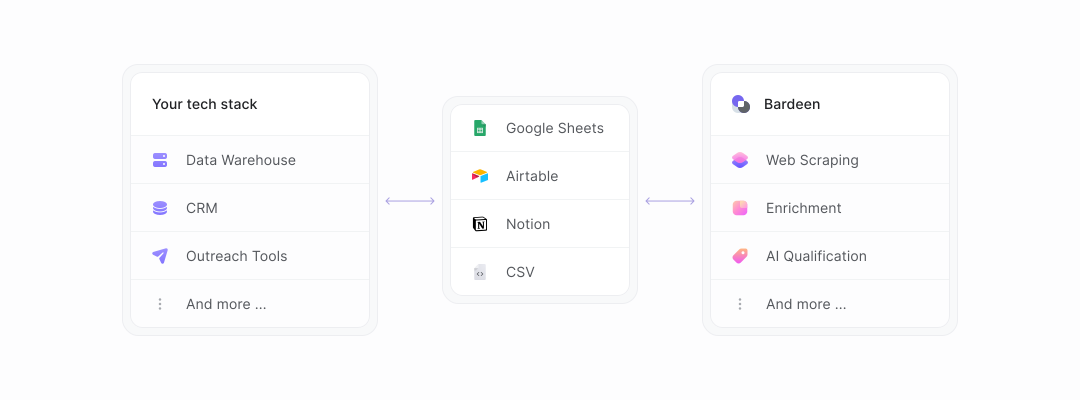
With our new Bardeen version, you can easily extract data from any website and discover new leads across the web. After extracting data from a website, use Bardeen’s powerful automation tools to validate and enrich your data, run additional scrapers on linked pages, or leverage AI to qualify leads and generate content automatically. Once your data is ready, you can easily export it to CSV, Google Sheets, Airtable, or Notion for further analysis and reporting.






SOC 2 Type II, GDPR and CASA Tier 2 and 3 certified — so you can automate with confidence at any scale.