.webp)
I’m calling it - the term “AI SDR” is the most hyped concept in outbound right now.
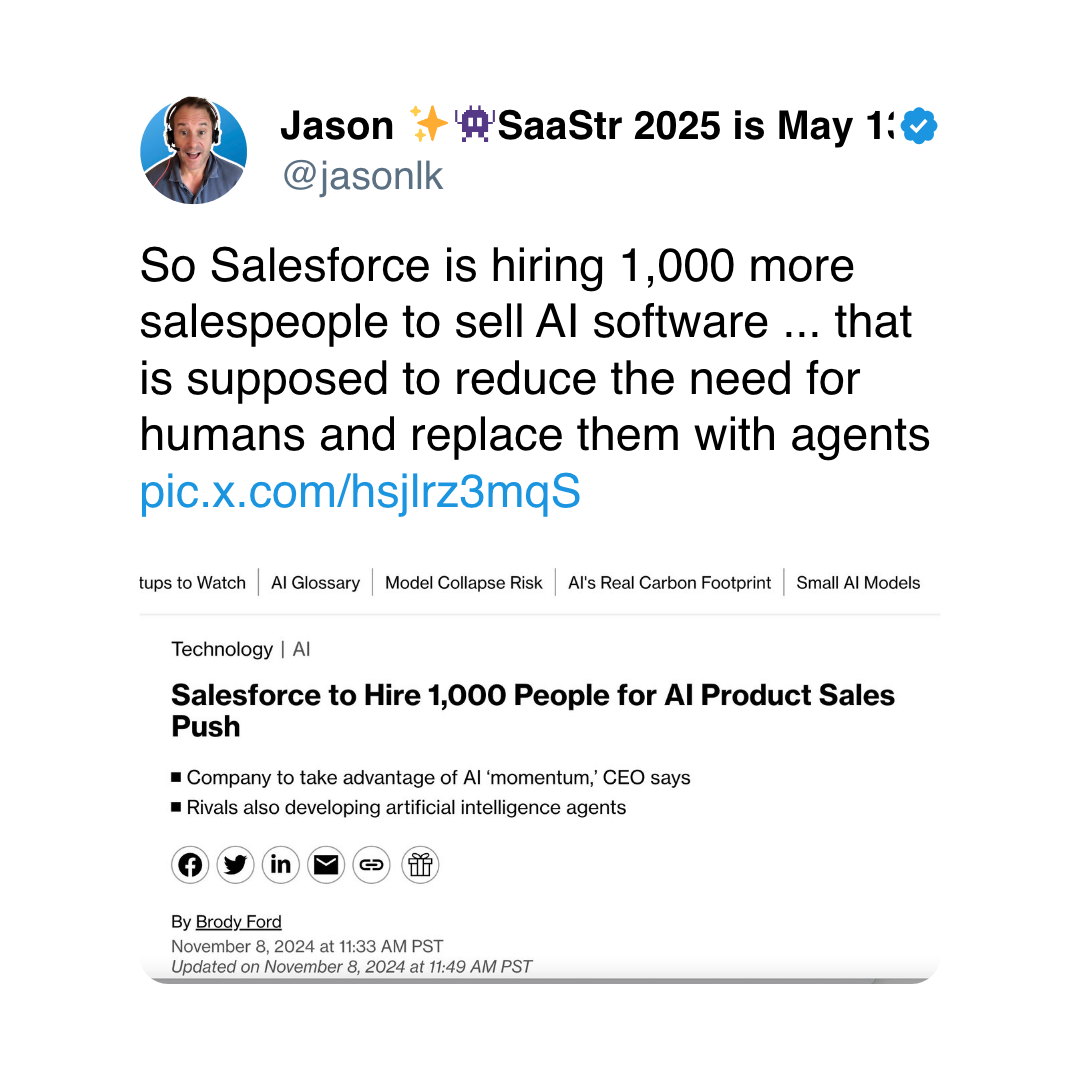
If you don’t believe me, just google “AI SDR tools”. See how many sponsored ad spots you have to scroll down through to get to actual content.
And don’t even get me started on LinkedIn:
Everyone’s talking about automating their outbound sales motion with AI.
But there’s a lot of hype and noise - let’s cut through it and explain:
Let’s dive in.
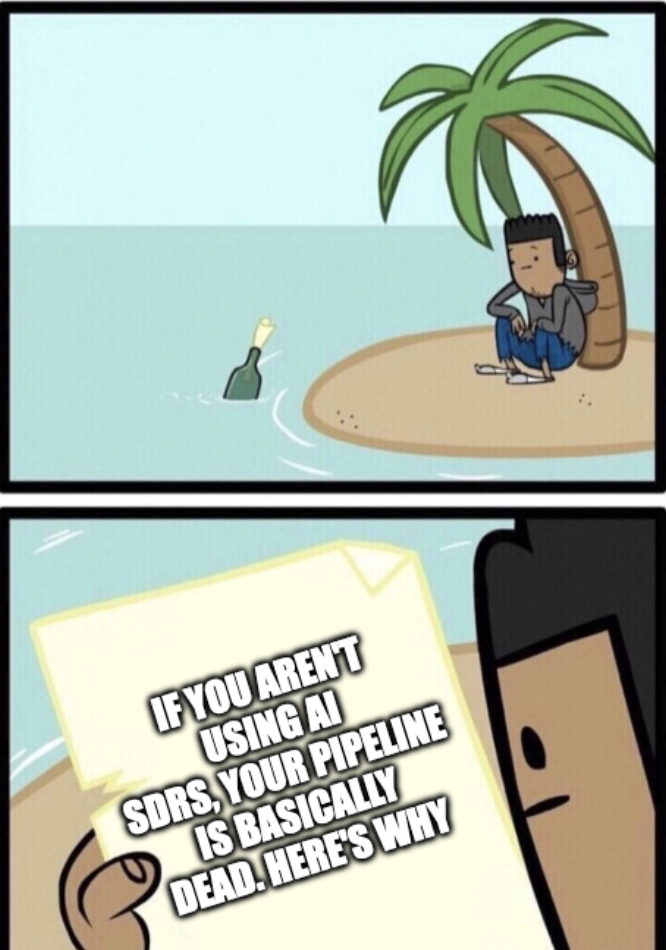
AI is eating traditional sales. But, why are we replacing sales development representatives (SDRs) specifically?
SDRs focus on the top of the funnel where all your leads lie, unfiltered. The reality is, most of them will never reply to an email or sign a deal, but you still need to make sure every lead gets a meticulously researched and personalized email.
It's high volume, high repetition, and painfully manual. In many ways, it's the perfect storm - prime for Gen AI to transform.

Plus, everyone wants to hit quota. In this economy, it’s no guarantee. Any solution that promises a better pipeline is something worth checking out. Especially if it means you don’t have to increase headcount.
It’s not wrong to think this way. Any sales leader SHOULD be carefully evaluating their sales motion.
Imagine a sales manager oversees a team AI SDRs, each working tirelessly while you sleep:
Each morning you wake up to a calendar full of meetings with qualified leads.
That’s the pitch, anyway.
But, if you're like me you don't take anything at face value.

As an AI company, we frequently ask ourselves, “where does the software end and AI begin?” With AI SDRs, it's more software than you think.
AI SDRs are multiple processes automated and bundled into a nicely wrapped package (sometimes frighteningly with a human face). What processes differ between vendors, but at its core, there are 5 tasks an AI SDR is performing for you:
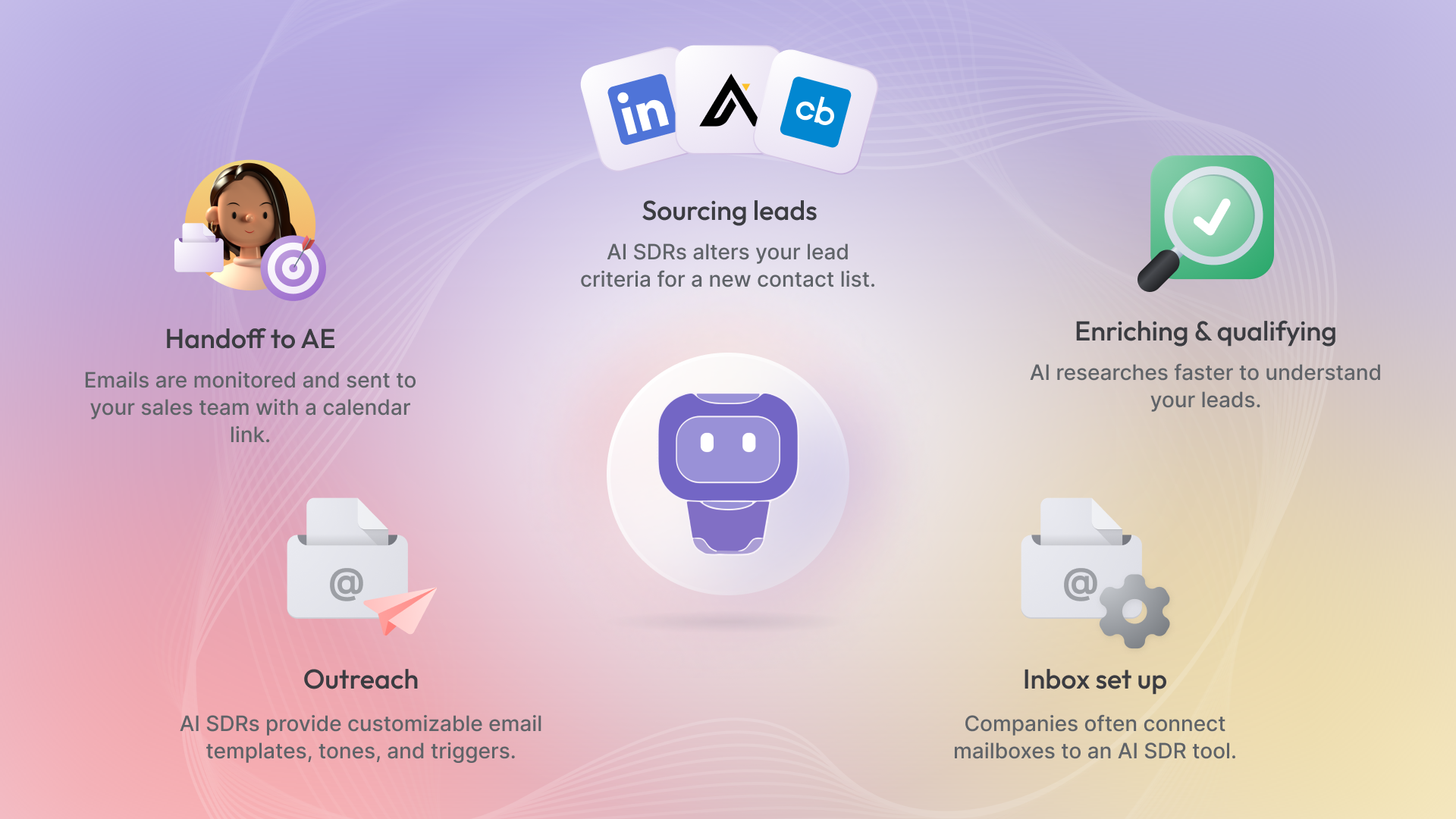
We’ll assume familiarity with these processes to some degree and focus on where the AI SDR is adding value.
AI SDRs source leads by tapping into pre-existing databases of potential customers. So, what are these databases?
Most products will try to hide the source and pretend like it’s magic, but under the hood, it’s the usual suspects your team is already using:
If they’re fancy (and expensive), you might tap into providers of intent data like 6sense, MadKudu, G2, RB2B.
And if they’re really fancy, they may have a proprietary database of leads or have AI Agents visiting 1st party sources to find leads for you. Like visiting conference websites, monitoring social media, or scraping industry specific directories.
What the AI does is transform your criteria (firmographic, demographic, and everything in between) for a great lead or existing lead profiles into what’s required to build a contact list of new leads. That means:
This step is fairly straightforward, but the cost of getting it wrong is also high. Wasted time and resources with poor-quality leads at every subsequent step in the funnel. That’s where lead generation automation and AI for lead generation come in.
Many sales teams are guilty of spray-and-pray tactics. Sending too many poorly personalized emails to too many unqualified leads. My inbox is a testament to that.
Why?
At this stage of the funnel, it’s hard to tell who will convert. With so many leads, it’s time-consuming and expensive to spend too many resources doing research on each one.
That’s where AI SDRs can shine. Doing more research in a fraction of the time to better understand your leads:
Better AI SDRs use proprietary prompts and training data that result in a more accurate categorization of a lead. They also retrieve 1st party data that’s up-to-date and unique - this is key for the best outreach. If you care to dig deeper, we’ve done research in both of these areas and built them into Bardeen:
18 months ago, warming your inboxes for cold outreach was an afterthought. Then, Google changed its policies for mass email senders (and other mail providers followed soon after).
This transformed the process of sending email into the non-exact science from a simple mail-merge, to the in-exact science of warming up inboxes. Note, this is most important for cold outreach, where warming up an inbox means better deliverability,
The leading tools in this space will recommend and help you do the following:
So, how does an AI SDR do this? They don’t. AI SDR products generally do not provide this service for you (unless you’re paying for some human at the company to manage these domains for you).
The most common model we see involves companies doing this on their own, and then hooking up the mailboxes to the AI SDR tool.
Now’s where the rubber hits the road, and we can start reaching out to prospects.
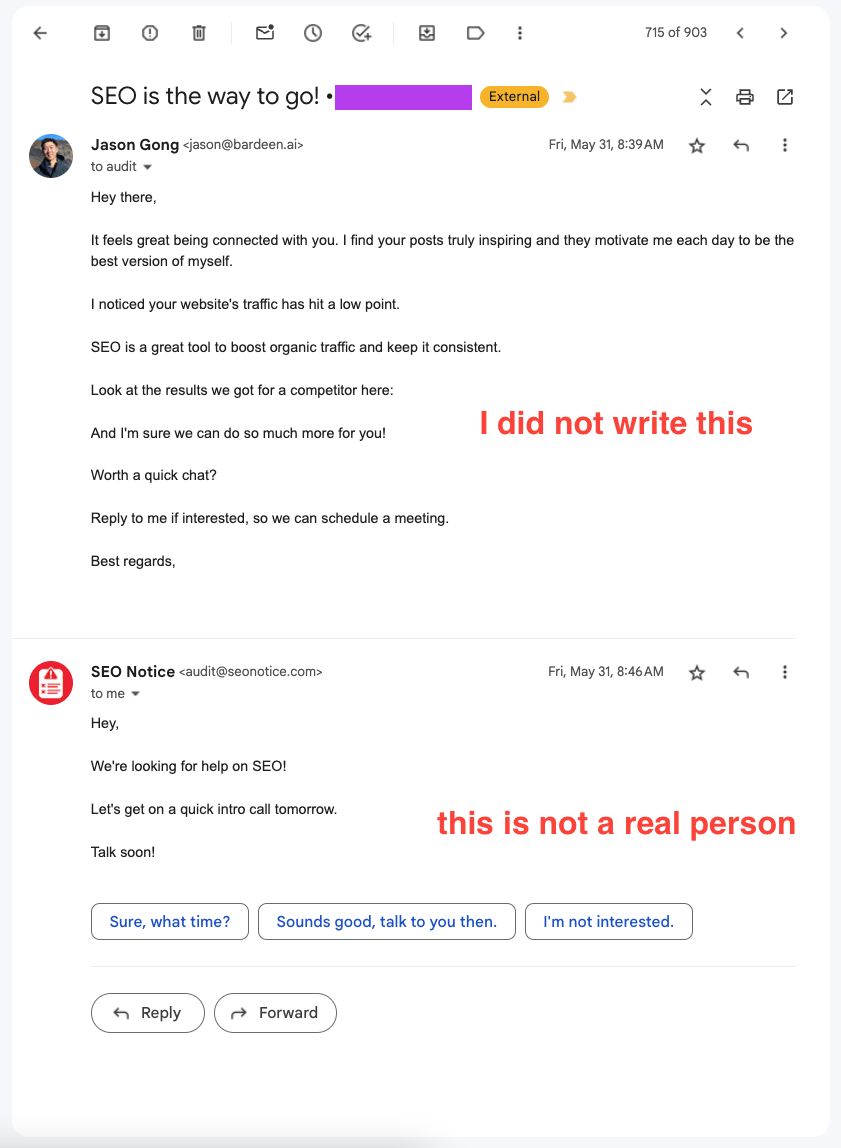
Email copy is generated with a sophisticated series of prompts that leverages all the data providers and 1st party research found in previous steps and is sent through the warmed inboxes.
If you’re lucky, the platform will give you room to customize the template it uses so things like this don’t happen…
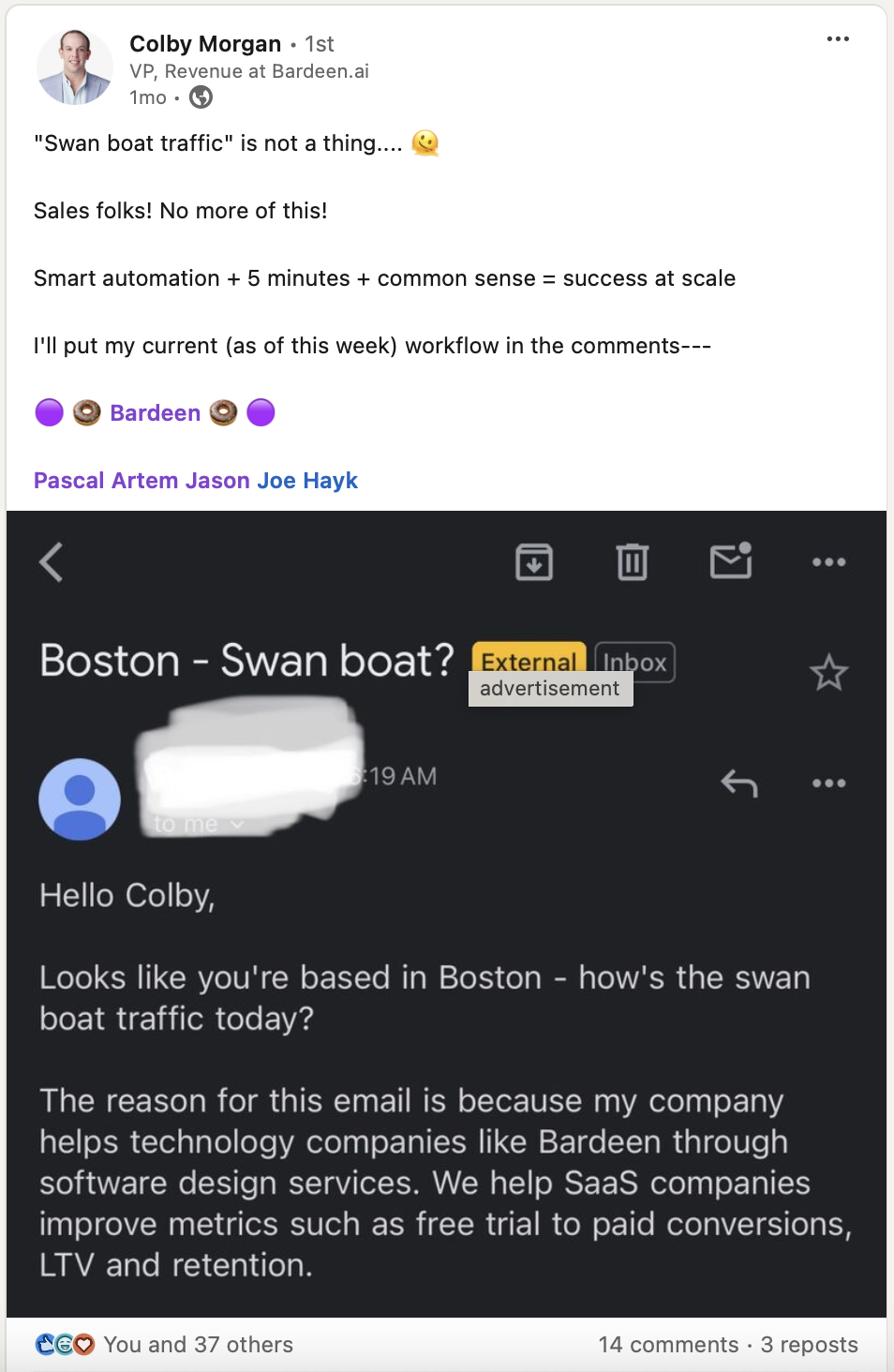
All jokes aside, AI (the LLM-based ones) is incredible at generating believable human-like text.
Good AI SDRs provide a customizable email template and matching controls for tone. The best also trigger emails at the appropriate time based on intent signals.
Lack of urgency kills deals. This means every hour you wait after a lead shows interest is money lost.
AI SDRs monitor the inbox for replies to sales outreach. Based on the reply, emails will be routed to your human sales team, automatically responded to with a calendar link, or disqualified.
A gap we see with AI SDRs is the lack of functionality once a human is in the loop.
Once a meeting happens, it’s about continuing to track the funnel so the human can focus on selling.
This leads us to the problem with end-to-end AI SDRs that promise to do it all.
I saw this highly scientific (/s) survey from SaaStr that gave some…interesting results.
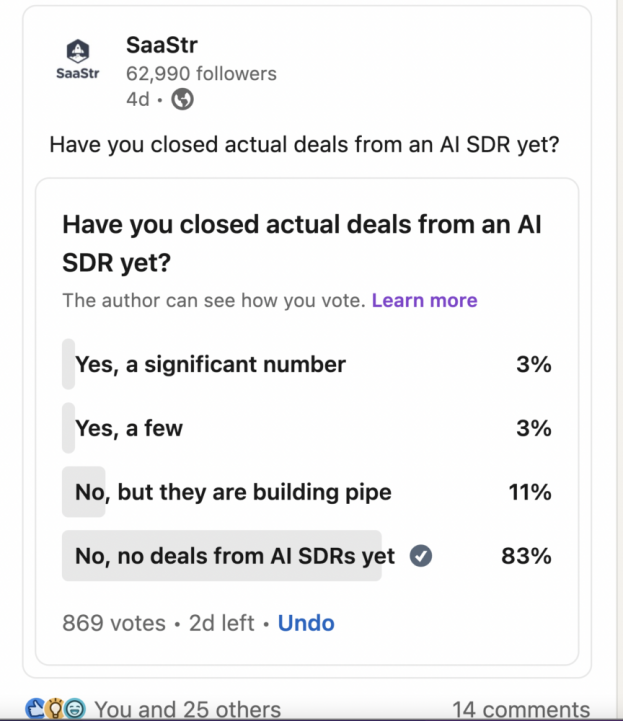
Now, this is an informal survey on LinkedIn, but by now you've probably also seen other posts with a similar sentiment towards AI SDRs.
Our take is that AI SDRs aren't a magic bullet. To have a successful outbound sales motion, you need:
There's no shortcut.
AI SDRs also come with their own problems. The promise is an end-to-end automated solution - set it and forget it for outbound. In reality, it’s unrealistic to suggest that.
First of all, AI can be unreliable for these types of tasks. One task with a 95% success rate is excellent, but AI SDRs string together chains of tasks. Ten 95% success tasks in a row ends up being a 50% chance of failure. How are you supposed to set and forget that?
In reality, it’s a headache to let AI handle everything. Sometimes, you want a human in the loop - to add context, put a personal touch on a message, or adjust structure. AI can’t handle every type of response, and you shouldn't expect it to. If you’re buying an end-to-end solution, what’s the point in expecting to get in the weeds all the time?
Plus, almost all of these companies are new solutions, creating their own workflows when robust tools already exist. An AI SDR won’t be able to craft HubSpot level email sequencing - you’re forced to use whatever UI and implementation the AI SDR has. They also use their own proprietary enrichment data - if you want to pull in from Apollo, you might be out of luck.
Hopefully, this gives you some peace of mind. Because no, your competitors aren’t getting miles ahead of you with fully automated SDR teams.

By now, I think you’ll agree the SDR job description needs an update. There are things that a human simply shouldn’t be doing, because AI is better.
AI might outperform humans in steps like inbox warmup, lead enriching and qualification, and automated outreach.
But you still need a human in the loop for a few key situations:
Put simply: we don’t recommend firing your team of SDRs and hiring infinite AI replacements.
There’s a better way.
The copy of all these websites starts with “Hire David, the AI SDR, to automate your sales motion.”
Then, they talk about the elephant in the room: “Actually, don’t automate everything. Humans should still be in the loop for X / Y / etc.”
That’s exactly how we designed Bardeen. Human-enabled with powerful AI automations, to improve your outbound motion.
Because, let’s face it. The idea is to replace the most junior roles on your team with AI SDRs. But…
Qualified AI-augmented humans will beat a salesforce of 20 AI SDRs. Every time.
Let’s take a look at all the tools you’ll need to do just ONE part of the sales motion: lead sourcing.
12+ tools just to source and qualify leads. Do you really trust an AI SDR to handle all those handoffs, error-free?
Bardeen supports more integrations, and allows you to make sure everything’s done correctly.
If you’re happy handing your entire sales motion off to AI, that’s perfectly fine.
But like we talked about before, reputation follows you. If you make a bad impression with generic copy and pathetic follow-ups, you’re digging yourself and your sales team a gigantic hole.
Not everyone wants to put their faith in the magic of AI SDRs.
We’re constantly adding new automations to Bardeen. Check us out to learn more.







SOC 2 Type II, GDPR and CASA Tier 2 and 3 certified — so you can automate with confidence at any scale.