
Create a HubSpot Ticket using OpenAI when a label is added to an email

This Playbook will use OpenAI to examine the contents of the currently opened email, generate a summary and title and log all the information as a HubSpot ticket when a specific label is added to the email.
Bardeen no longer supports Autobooks & Playbooks. Learn more about the new Bardeen.
When label is added to email
Trigger
Get summary of a text by OpenAI
Action
Generate text from model
Action
Create HubSpot Ticket
Action
Steps:

Automating customer support processes can be a game-changer for any business looking to improve efficiency and responsiveness. Bardeen's workflow automation uses OpenAI to intelligently analyze emails and seamlessly create support tickets in HubSpot. When a specific label is added to an email in Gmail, the playbook activates, summarizing the email's content and generating a ticket title for use in HubSpot. This frees up time for support teams to focus on solving customer issues rather than on manual data entry.

Here's how this workflow creates a HubSpot ticket using OpenAI:

  • Step 1: Email Label Trigger - The workflow starts when a predefined label is added to an email in Gmail, indicating that an issue needs to be addressed in HubSpot as a ticket.
  • Step 2: Generate Summary with OpenAI - OpenAI is then utilized to read and summarize the contents of the email, providing a concise overview of the issue at hand.
  • Step 3: Merge Text - Bardeen merges the text elements to create a descriptive title for the HubSpot ticket, ensuring clarity and relevance for the support team.
  • Step 4: Generate Ticket Content - OpenAI generates the text that will form the body of the HubSpot ticket, detailing the issue based on the email summary.
  • Step 5: Create HubSpot Ticket - Finally, the workflow creates a new ticket in HubSpot with the generated title and content, placing it in the appropriate pipeline for action by the support team.

The new Bardeen – Find leads no one else does:

With our new Bardeen version, you can easily extract data from any website and discover new leads across the web. After extracting data from a website, use Bardeen’s powerful automation tools to validate and enrich your data, run additional scrapers on linked pages, or leverage AI to qualify leads and generate content automatically. Once your data is ready, you can easily export it to CSV, Google Sheets, Airtable, or Notion for further analysis and reporting.
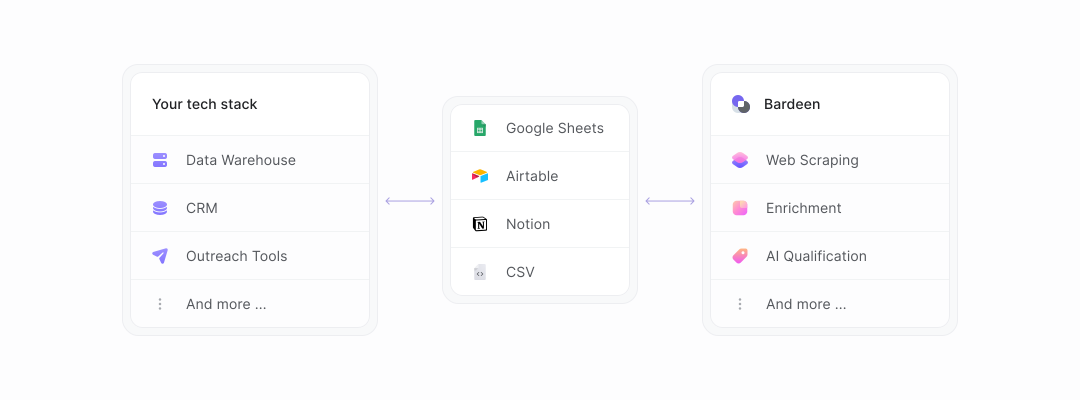

How Bardeen integrates with your existing system:
With Bardeen, you can easily import and export data to spreadsheets or CSV files, then push it to your favorite CRM or outreach tool — like Salesforce, HubSpot, Pipedrive, Apollo.io, or any platform that supports CSV. Most tools offer built-in import options or third-party solutions, making integration seamless and keeping your workflow uninterrupted.
Data Sync between Bardeen and your Tech Stack

"Our Sales and Ops teams can do more in less time to help serve our customers better."

Alex Bouaziz
Co-Founder & CEO at deel.
Enterprise-grade security

SOC 2 Type II, GDPR and CASA Tier 2 and 3 certified — so you can automate with confidence at any scale.

Frequently asked questions

What is Bardeen?
What tools does Bardeen replace for me?
Who benefits the most from using Bardeen?
How does Bardeen integrate with existing tools and systems?
What are common use cases I can accomplish with Bardeen?
By clicking “Accept”, you agree to the storing of cookies. View our Privacy Policy for more information.